I go for rows most of the days when this loch of the river mouth is relatively calm.
I row partly because each day I need to look at the horizon. Some days I want the height of the headland or the boulder-piled breakwater and the prospect of Harris and Lewis rising a little higher. However, other days I want to be on the same surface as the horizon, to be level with its elongating distance, the flat bottom of our tender licked fast to its constituent sea.
The rowing also has the purpose of holding my nerve. Since we’ve been docked on pontoons all summer, indirectly land-tied, I miss living at anchor and fear I’ll lose my hard and slowly-won ability to row solo on the sea.
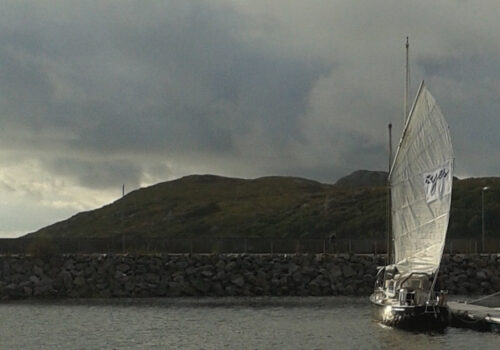
My rowing ritual isn’t grand. I untie myself from our floating dock, push myself out from the sheltered pocket of water behind Ara’ Deg, slide the oars into the oarlocks, plash quietly round the last finger of the pontoons, and ease out alongside the breakwater. I keep an eye out for any large fishing boats that look like they might be about to head out, or fast ribs, which make big wakes which scare me. But all the same, while I’m still in the harbour, I am in man-made shelter – until I work myself round the end of the breakwater and into the pull of the open horizon.
This is the turning point, where I feel us – the boat and I – rock as the ripples of wave or rib or fishing boat reach us, where I feel the breeze rise and ruffle, feel the tide ease us back or on.
I adjust our direction and pull straight out to sea for a few strokes, veering slightly north-west or south-west to be riding directly into the wind, if there is any, keeping perpendicular to the line of waves to take the rise under our bow and avoid being rolled side-on. Then I steer us round the back of the breakwater, out of sight of the visual security of the harbour.
Now I am alone with the horizon, held between the long-ridged arms which hold it out afar. A couple of small humped islands hover at the mouth of the loch and beyond those Harris and Lewis sometimes float on the other side of the Minch. I stare out and attempt to read the horizon, attempt to absorb and understand whatever lies upon it. And then I just sit, or bring in the oars and lie back on the steady lilt of the water, closing my eyes or gazing skywards, letting myself drift in this rolling sheen between the sea surface and the underbelly of the sky.
I never rest completely, my mind taut with watchfulness and fear of the water. And after a little time I rouse myself, rise, dip the oars back in, and turn us around to row back, watching the horizon close gradually with each small stroke, relieved and sad to be returning.
This ritual is always the same and always different. Sometimes the whole sea is sunny, like an open blue field. Other days it is closed, distant and grey. Today it was cloudy where I sat and swayed and drifted but the clouds were shifting and splitting and, further out, a bright patch of water lay under the sun, broken by the wind into shimmering speckles of light.
Looking at it filled me with an acute longing. It was irresistible: a glad glimmering, a golden gleaming, a meadow of heaven cast to the surface of the sea… so I rowed towards it but it was impossible to reach. As I approached, the scattered glimmers widened to slim liquid lines, sliding along the ridge of each rippling wavelet. Even as I felt the sun on my face and arms and knew I had arrived, the flickering shimmers receded and receded.
It’s always further on, you see; it’s always further on.
Loch Inver, Assynt Sutherland
2nd August 2014