morning
Leaving in the early morning,
moisture rises off the rice fields,
the blue ridges of the mountains dissolve.
Fukui, Japan
9th October 2014
Leaving in the early morning,
moisture rises off the rice fields,
the blue ridges of the mountains dissolve.
Fukui, Japan
9th October 2014
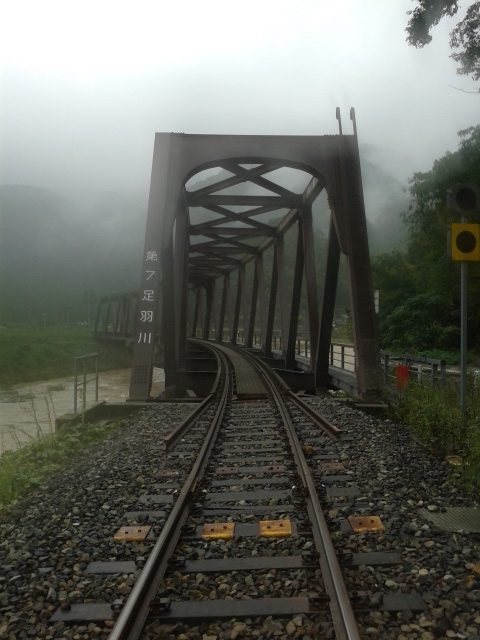
Miyama, Fukui, Japan
8th October 2014
I am folded within the green mountains of Miyama. The weather is warm. A light rain has just fallen, diffusing the thick wall of cedar-green foliage that fills the window. We are in the Kurumaya Taiko Dojo. Dojo means ‘the place of the way’ and it is a beautiful place: a large high-ceilinged low-windowed room with a warm hinoki, cypress, floor. The walls are wood-panelled as well, and hung with prints and scrolls of Kurumaya-sensei’s calligraphy, and photographs he has taken of Miyama in snowy and summer seasons.
It feels very natural to be here, perhaps because the room itself feels natural, perhaps because natural elements gather here. It is a room made of wood and paper after all, and a room made of skin, with taiko, drums, lining all its walls.
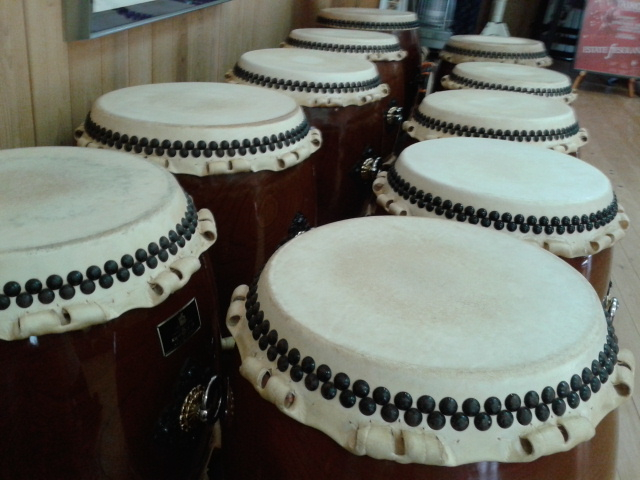
There are taiko of many forms and sizes – small taut shime and little hand-held uchiwa fan drums, as well as huge uchiwa, and an odaiko (‘big drum’). There are also several light barrel-construction okedos and – my favourites – rows and rows of nagado, ‘long-bodied’ drums made from one piece of hollowed wood with the skin tacked tightly around.
The skin of the taiko is cleaned cow skin and the room reverberates with it as we draw the drums into a circle and, pulling our own skins taut over our muscles, beat and sweat and beat.
Out the window, beneath the green cedars, the mineral-blue river gurgles slowly along the valley floor. Above it, just visible in the rock of the facing mountain, are three little stone Buddhas. They sit all day long, as we come and go, in their fading red bibs in their little hand-carved holy place. It’s good to have a home.

Kurumaya Taiko Dojo, Miyama, Fukui, Japan (taiko made by Asano Taiko)
8th October 2014
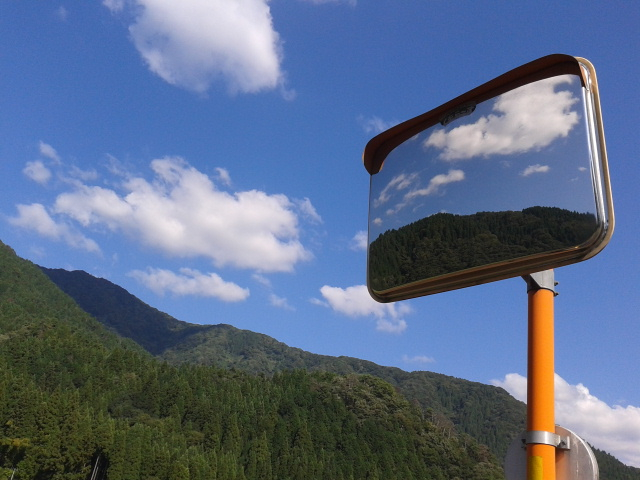
Miyama, Fukui, Japan
7th October 2014
South west out of Tokyo the road unravels, from the gridlock of skyscrapers, through scattered suburban sprawl, and down and out towards the mountains, rising like blue waves ahead.
The hills look young, sharply ridged and thickly wooded, bridges like scaffolding bracing their narrow valleys. The road winds beside and between them, beneath groves of yellowish bamboo fanning their slopes like giant feathery ferns, and intermittently crossing turquoise-green rivers which slide out from the valley floors.
Japan is either steep or level. Where the hills stop, the plains start, and the rivers then meander slowly across them, between yellow rice fields and grey cities, out towards the shining pacific sea. The road veers out from the mountains to follow them, and before long we are rolling alongside the flat southern sunshine of the ocean while the land concertinas away – like a dream – in fading blue folds to the north.
*
first glimpse of Mount Fuji above the mountains
hanging flat
like a ghost or a backdrop brushed in palest
(almost transparent)
blue
Bus from Tokyo to Fukui, Japan
1st October 2014
There’s a lot of vegetation in the quieter districts of Tokyo and, since the streets aren’t named, and since most of the buildings look similar, I rely on the plants to navigate and find my way around. They become familiar: the pink flowering tree, the green fluffy maple with its leaves like a thousand tiny hands, the tall red-turning hedge, the pale green conifer with soft feathered claws hanging.
The trees are distinctive here, thankfully, and exotic. And they seem to grow to suit their district. Twisted Japanese-looking pines predominate in the small stone household courtyards, often pruned and wrapped into bonsai-like shapes, but in the backstreets of the bustling bright district of Shimbashi, I found a shrine complex where the trees rose almost as high and straight as the skyscrapers surrounding it.
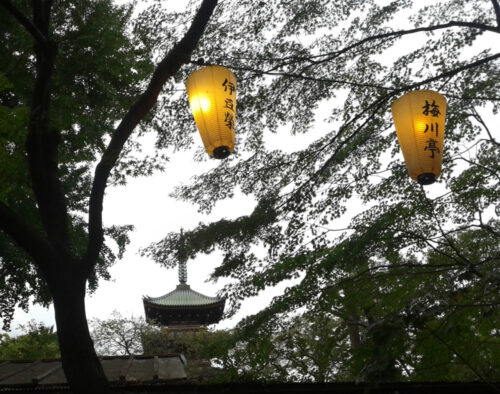
The numerous trees in Tokyo are a pleasant surprise to me. The other surprise is the multitude of hidden shrines, tucked away in the corners of parks, in back alleys, between skyscrapers, behind trees. They’re little pockets of peacefulness and I seek out their solace regularly. I feel strangely reverent and slightly magical in their presence, as if I’ve slipped back in time a little and can become part of the ceremony and power of the shrine. It’s a simple ritual: offer a coin, make a prayer, toll the bell, clap your hands, twice (to wake up the gods), then bow and quietly depart, having washed your hands and mouth in the spring water fountain before entry. Old rites of purification and desire.
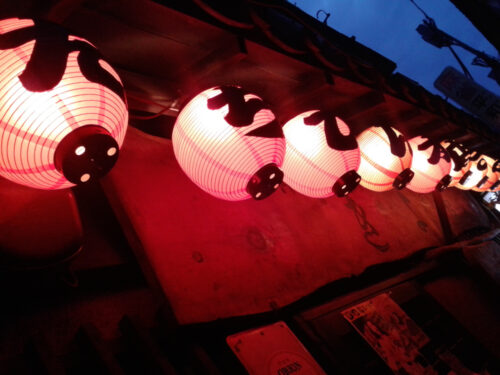
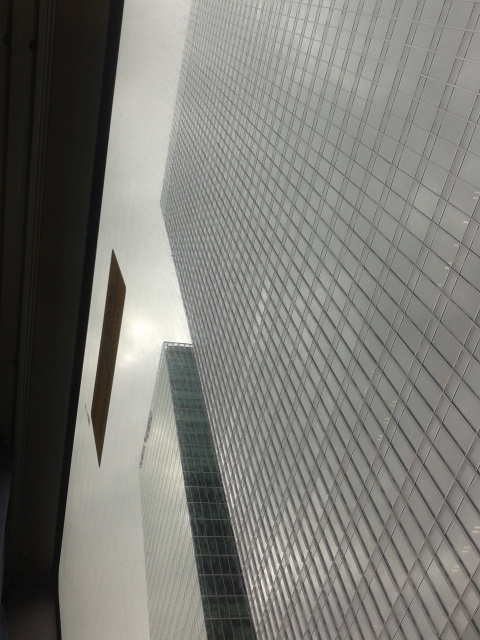
And then I can return, when I must, to the crazy Tokyo – to the long downtown streets lined with neon rainbows of high-rises, or to the weaving maze of backstreets, crammed with tiny restaurants and micro-bars, bathed in the softer glow of paper lanterns and a haze of smoke and cooking smells.
I walk and resist, walk and resist, enjoying the myriad lights of the outdoor Tokyo, until I am lured by necessity into the network of metro stations and malls, where I force myself to submit. Then I drift hopelessly along the fluorescent platforms and passageways, with their shining shops and beckoning kiosks and high female voice-overs which explain and apologise and cajole. No electricity is spared here. And I could become part of it, become just another pixel in the smooth lighted buzz… but every few minutes I’m jolted out of my synthetic reverie by another taut announcement, with its childish melody chiming loudly along beside it.
Ah, Tokyo. It panics and charms me by turns, and I can’t wait to get out.
Tokyo, Japan
29th September 2014
Tokyo, Japan
28th September 2014


Ueno Park, Tokyo, Japan
27th September 2014
Soft green onions, gluey white daikon, and skin-coloured flakes of fish, curling gently in the heat of our breaths. Add these to the blue and white porcelain bowl which you’ve half-filled with a thin soy-based sauce, poured from a round ceramic jug. Break apart the cheap wooden hashi (chopsticks) and mix the green onion, the white daikon, the skin-like fish flakes, and a dab of gloopy green wasabi into the sauce. Pick up some of the dark dry green strips of nori (seaweed) and sprinkle them on top of the pale slippery soba (buckwheat) noodles. Lift some of the noodles from their red and black lacquered box, handling them with your hashi as best you can as they slide and slither, and place them into the bowl of sauce.
Now and then pick out one of the assorted shapes of lightly fried battered vegetables (tempura) that sit in another of the bowls on your tray (the one which looks like it’s red underneath is sweet pepper, the one which forms a lattice shape like a noughts and crosses board you don’t know). Dip these into the sauce too. And eat. Oishi desu. Delicious.
When you are finished plucking and sucking and mixing and crunching, pour half a cup of liquid from the square teapot you’ve just been given – it’s the water the noodles were cooked with – into the small handle-less cup, and pour in the remainder of your sauce. And drink. And look from the counter where you sit through the hatch into the compact kitchen, stacked with bowls and trays and black and red boxes, where the cook-proprietor stands resting in the heat with a white rolled-up towel tied round his forehead. His sweat beads as the condensation does on the sides of your glass of iced (and probably mildly radioactive) water. It’s so hot the air is chewy. A typhoon is on the way. It was hard to sleep last night because of the building heat but also because intermittently your room was trembling slightly. The tremors were subtle, barely perceptible, but you woke and knew that nothing was stable, not even the ground beneath you. But the food is good here. And since almost nobody talks about it, it’s easy to forget to question its radiation content.
Itabashi, Tokyo, Japan
22nd September 2014

Tokyo, Japan
21st September 2014