anew

One of the good things about having an impaired memory is that each season is new. This is my sixth spring since the concussion I haven’t fully recovered from, and my sixth successive spring here in Lochinver, but it could almost be the first.

It’s not that I don’t remember last spring but it feels so far away that it’s as if it happened years ago. I do have some feeling of familiarity: as I walk along the slim path beside the river, the intense green glow of the young beech leaves in the evening sunlight arouses a sense of recognition, of greeting, but it’s faint and indistinct, like the memory of something once loved but long gone, and difficult to firmly recall.

I walk on, following the path until it reaches a bend in the river and falls into shadow, then turn back. Now the sun is in front of me, low in the north-west. Its golden light is filtered through the varied arboreal foliage generating green hues of vivid tenderness. I stop in a copse of beech trees and soak it up: a sweetness of light, and a sweetness of flavour too as I pluck a handful of the smaller leaves and fold them, one by one, into my mouth. Each leaf is soft and downy on my tongue and as I bite down, a subtle succulence is released. This feels more familiar, as if the tongue’s memory is more faithful than the eyes’ and I’m reassured to know that my body holds what my mind can’t easily access, although, I tell myself, what matters is what’s present now.

I stroll a few steps further then am stopped by a rowan, its emerging fistfuls of leaves brightly backlit, their serrated fringes casting finely-toothed shadows on each other as they layer and overlap in their open field of light. It’s the mosses which captivate me the most, however, covering the rocks by the path and the larger boulders alongside, thousands of tiny hairy fingers thronging upward in silent solar supplication. They seem to glow of their own accord, as if they’re not reflecting light but emitting it, and those in the shadier pockets of the wood appear almost phosphorescent.

The fire in leaf and grass
so green it seems
each summer the last summer.

Despite my disrupted memory of recent years, I still remember this stanza of a poem* we studied at high school: each summer the last summer, each moment the last and only of its kind. In my case, now, it’s the inverse: each season the first season, each spring the first to generously and gladly unfurl. I don’t think it matters though. It’s the gratitude which counts.

*Living by Denise Levertov

River Inver, Assynt, Scotland
8th May 2026

afterwards

It always impresses me how bright the colour green is after snow. We’ve only had a week of snow cover, a fraction of the successive months I used to undergo in Quebec, yet as the grass reveals itself again it appears supernaturally viridian. The dullness of the day enhances the effect, the persistent rain and low grey cloud allowing the hues of the ground to come into their own, glowing with an inner luminance and seeming to rise out of the earth towards us.

I’ve loved having the snow. I’ve loved the simplicity and purity of the visual landscape and skyscape, the soft white carpet and laden charcoal-grey clouds completing each other in a quiet monochromatism. In Quebec, the snow stayed for so long that by February I would be longing for greenness, like a physical thirst. I don’t feel that now. Indeed, our snow spell has been all too brief. But something in me does feel relieved and enlivened—satiated—by the visible verdancy, the lurid green allure.

Lochinver, Assynt, Scotland
11th January 2026

asphodel

We were nine women walking, tramping over bouncy heather moorland above the steep shores of Loch a’ Chàirn Bhàin, when one of us stopped to point out a bog asphodel which was just coming into flower. We gathered round and marvelled at its starry yellow blooms and another of us remarked that, in addition to the Elysian Fields of Greek mythology, those blessed green meadows of the afterlife, there were said also to be asphodel fields, though she noted this probably did not refer to bog asphodel.

I looked this up online when I returned home and found that, while the Elysian Fields were reserved for the righteous (along with gods and nobles) and a hellish land called Tartarus was set aside for the wicked, the fields of asphodel were allotted to ordinary folk.

The significance of the asphodel is debated. Some Greek writers felt the paleness of the petals evoked a pallid, ghostly quality, while others drew on its more ancient connotations of fragrant fertility.

Even in the latter case, however, I sense these asphodel fields are not for me, nor the endless blessings of Elysium. In the afterlife, I want for my part only a rolling peatland, grown over with purpling heather and green and gold grasses, with viridian clumps of moss glowing in the fine northern sun, and everywhere the pure yellow stalks of bog asphodel standing upright like tiny sentinels of joy.

Perhaps, for those of us of Scotland, we can spend our eternity meandering in such a place, gazing into lochans and reflecting in the clear summer light. When I think of it, however, I find myself imagining not a summer moorland but an autumnal one, the grasses turning amber and bronze, the dried heather flowerheads becoming that lovely muted mauve, and the bog asphodel vivid orange, its little tongues of flame everywhere sparking, everywhere speaking of warm hearts and hearths in the cool oncoming dusk.

And no more midges.

Torr a’ Ghamnha, Assynt, Scotland
6th July 2025

hazel

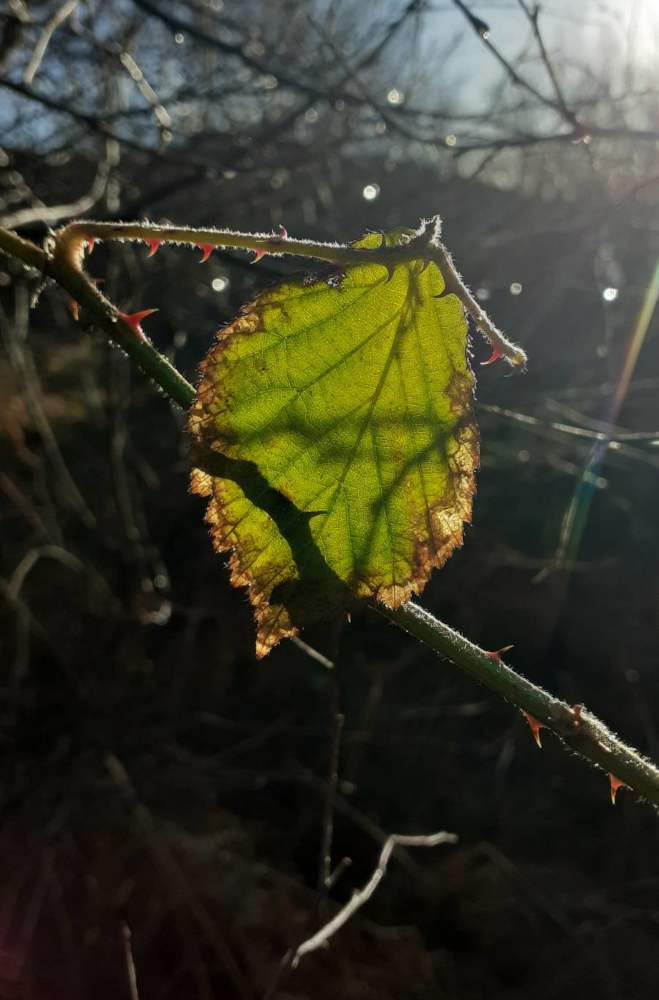
bright green and yellow backlit hazel leaf with sun-dappled trees in the background

beneath the feathered yellow haze of the larch
and the tiny gold coins of the birch leaves
the last green fires alight

Culag Wood, Lochinver, Sutherland, Scotland
26th September 2020

enough

What more could you ask for
than green mossy grass
beneath trees
in sunlight?

Culag Wood, Lochinver, Sutherland, Scotland
27th April 2020