settled

snow with a few gold grass stalks poking through

The world has been settled with a soft kindness. The sun glows with it. The pink tinge of the dawn lingers. We all feel a little tender. Our cups of tea steam up the windows, diffusing the whiteness outside into a gentle haze.

When I worked in a cafe in Montreal, we noticed that people were different the first morning it snowed. They would drift in off the street, snowflakes still falling from their hats and hair, looking around as if in a slight daze, the women leaning their heads a little wistfully, the men asking for their coffee in a quieter voice.

The atmosphere seemed to become a bit romantic and, when I could, I would put Ella Fitzgerald on the stereo and although we didn’t dance it felt like we were all yearning to – to slowly twirl each other around the pastries and croissants, and touch each other on the cheek, and melt a little…

Cwm Garw, South Wales
14th January 2024

River Inver

The whitest water I’ve ever seen was at a “minor waterfall” near Mount Fuji in Japan. It wasn’t just the whitest water, it was the whitest whiteness I’ve ever seen, wild and tumbling in a rapid thrash of motion, shattering like diamonds as it smashed round the rocks, poured over, frothed down.

The River Inver is brown in its depths, its spuming foam yellowish as it roars on. But still – the illuminate flashes, the diamond fragments scattering –

River Inver, Assynt, Scotland
28th October 2024

Siberia

It feels quiet up here, and protected, as if I am insulated within the inarticulate drone of the plane. Above, the air is blue. Beneath, the mountains fold and the plains stretch themselves out, and across them, the landscape is writing itself.

It begins first as one line, an elegant calligraphed curl scrolling out across the horizontal distance; then proliferates, until there are several lines, breaking and branching from each other, scooping and scrawling in liquid loops of sunlit gold.

They look a little like Arabic forms, like continuing sentences, slowly writhing on; scribed and scribbling, delicate yet definite. The spread plains between them are pocked – punctuated – with still water, like ink spilt and spattered and gathering into myriad tiny pools.

As we fly further north, snow softens the mounds and valleys and the curves unwind, becoming thick and white, and finally coalescing into great lakes, held high on the bronze plates of the sun.

It is quiet up here. No-one is talking since most of the plane’s inhabitants are sleeping. But my eyes are alive with this beautiful unspoken language, this secret script of low sunlit water and wide wind-smoothed snow.

Flying over Siberia
21st October 2014

Nantai-san

Nantai means ‘man’s body’ and the body of the mountain is varied. I climb through tree roots and torii (shrine gates), clamber over boulders, and slip on muddy sand and sharp rubble. The mountain is a volcanic cone, much like Mount Fuji, and it is a sacred mountain, a shintai, something which holds kami, spirits.

The path to its summit is difficult yet popular. By mid-morning, I’m meeting many elderly Japanese who are already on their way down, and several younger (middle-aged) men. The latter are dressed all in white, the colour traditionally worn by mountain pilgrims and the yamabushi, the mountain ascetics who lived here in earlier centuries.

Whiteness appears regularly on the path. The torii at the foot of the mountain, which I passed through to ascend, were dressed in strands of straw rope and hung with the folded zigzags of white paper which indicate a sacred place; and beside the path white plastic strips are tied around occasional tree trunks at eye level.

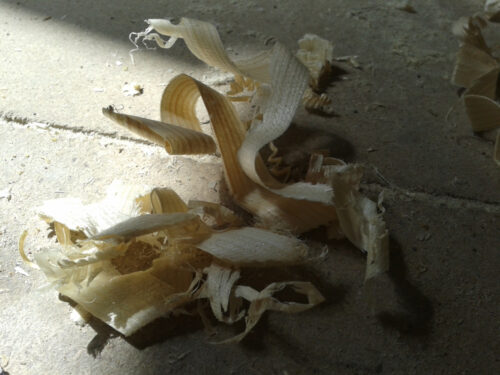
As I make my way up, I also start noticing fine curls of pale birch skin lying intermittently beside the trail. At first I pocket them as miniature mementos then realise they’re too regularly placed to be chance arboreal sheddings, and start myself dropping them along the way as I continue. The trees themselves are changing as I get higher and white birch trees become more frequent until, at the edge of the trail, on a steep curve of the mountainside, stand a line of them, their loose peels of bark unfurling, and as the breeze catches them, they flutter in the sunlight like the paper strips on the torii.

At a tiny shrine set into a rock face a few hundred feet short of the summit, the birch disappear completely, and the world becomes comprised of twisted pines, bleached dead limbs and stumps, and reddish volcanic soil. A sudden cold wind arrives and, as I climb, the trees and soil finally give out until there’s only sharp lumpy black and red rock, and a steep open rubble slope to the summit.

It’s a surprisingly difficult scramble up but, along with the old lady who’s appeared beside me, I get there. The summit is graced by one main shrine and two smaller ones, and I find a sheltered place to nestle by one of these subsidiary shrines, on the far end of a ridge slanting off to the north.

Lines and lines of blue hills rise and fall into the haze of the western sun (Fuji-san hiding somewhere to the south) and the north is full of steep peaks pointing and spearing the mat of thick grey cloud above them. I’m sitting behind some lumpy black rock, having daifuku (sweet red bean patties) and green tea, when I notice tiny white particles drifting around me. At first I think it’s tiny flies, then I think it’s dust, then I’m sure it’s ash, then, as a tearing wind sets in, I realise it’s snow. I barely get back across the ridge and down to the treeline. The wind is like walls of ice, scouring and freezing. I have never been at this altitude before. The world whitens, sharpens. I am blown away!

Shinto Torii gate at top of Nantai-San

Nantai-san, Nikkō, Tochigi, Japan (2486m/8156 feet though I start from Chuzenji at 1269m/4163 feet)
17th October 2014

Nikko

wee backyard shrine in Nikko

Wandering around the back streets and alleys of Nikko, I notice every second or third house hosts a small shrine in its tiny walled grounds. Most are red-painted, often with complete with a small torii (gate) as well. Even on a patch of wasteground between houses, there’s a miniature stone shrine. Two white porcelain beckoning cats, which bring good fortune, sit either side of its narrow portal, and a glass of sake appears one morning as well.

I love the flashes of red, the glimpses of gateways, crimson thresholds. At the edge of town is a wooden bridge so sacred you have to pay 300 yen to cross it. It’s also red and curves gently across the green-blue river, bringing out the vermillion tints emerging in the forests which rise steeply above it. Red times, times of changing. We are on the cusp.

Nikko, Tochigi, Japan
16th October 2014

Shiraito no Taki

A turquoise-pooled paradise
in a bowl, a basin
hung with white strings

myself at Shiraito no Taki

Shiraito no Taki (‘waterfall of white threads’), Fujinomiya, Shizuoka, Japan
14th October 2014 (photograph by Uemura Katsuhiro)

Fuji-san

Rising naked at dawn
gathering a soft shawl for the morning

At sunset
held aloft on a shrug of rosy white cloud

Fuji-san from Fujinomiya

Fuji-san from Fujinomiya, Shizuoka, Japan
14th October 2014