March
Warmth. I can smell it.
Cwm Garw, Glamorgan, South Wales
17th March 2016
Warmth. I can smell it.
Cwm Garw, Glamorgan, South Wales
17th March 2016
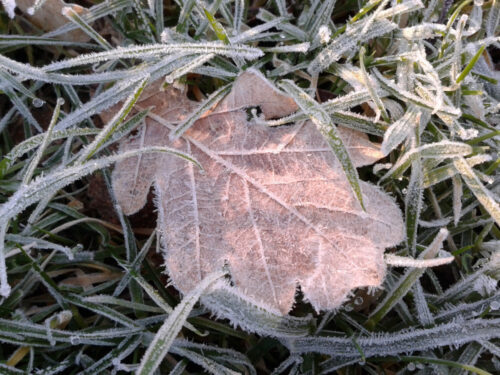
A frost meadow lies between the spreading oak trees and the slim birches, great palmfuls of leaves papering over the dew-sharpened blades, each of which is itself furred by myriad tiny hairs of frost, glittering in the first light, sun upon sword upon sward.
Queen’s Park, Glasgow, Scotland
23rd February 2016
It’s the wee things, always the wee things. Whether in the middle of the daily routine or swept up in a great adventure, it’s the small gesture which catches us and which somehow, surprisingly, completes.
On the moortop, the stretching views and snow-struck hills are focused into the tiny buffeting of a small white downy feather caught in the yellowed grass. On the sea, the rough grace of the Minch is collected into the handful of froth thrown up by a rogue wave slapping us broadside, which catches the sun before it falls, making a momentary rainbow.
Beauty blooms so quickly.
Cwm Garw, Glamorgan, South Wales / The Minch, north-west Scotland
11th February 2016

Pontycymer, Glamorgan, South Wales
20th January 2016
It was an awkward night. I didn’t know anyone in the hotel bar so I propped myself up against it and drank Glenkinchies a little too quickly while trying to make conversation with the karaoke singers when they came for refills. Midnight finally arrived with free drams and cubes of tablet and, after shaking hands with enough strangers, I went outside.
The moon hung above the eastern arm of the town like an old lamp, huge and half-lidded, kept company by a few tiny white stars. Bulging black waves banged heavily at the harbour wall beside me, their hefty slap reverberating round the deep indent of the bay. And I felt like the stars, far and high and distant from the glad swelling tides in the bar; and cold in this country that I thought was my home.
Millport, Cumbrae
1st January 2016
The internet is my box of delights. Today I opened an advent calendar story about a handmade angel on the top of a Christmas tree. I found a turfed roundhouse to buy in a wooded Welsh valley. I discovered that Switzerland is holding a referendum on stopping banks controlling the money supply. I saw taiko drumming in the golden haze of dim London lamps. I wrote to friends and recalled shared memories. I remembered other times. I imagined other times. I glimpsed other places.
And all while I sat here at a small stained table in our unheated and unfinished upstairs room, quietly warmed by bright wavelengths of electronic light and the variousness of the world, until I closed the laptop lid and carried it away. Such a portable portal. What will it open next?
Pontycymer, Glamorgan, South Wales
12th December 2015
The sun is a foreign thing, rising surprisingly from a puffy cloud on the Irish sea, limpid, lucent and pale, pale golden; a strange foreign thing, washing itself through rushes of rain as the car ferry reaches the shore, then flooding the low southern fields till all is glowing, green glowing, like a secret spring in the middle of winter.
Four, five, six weeks, we’ve had a drought of light, living dimly in the grey-ceilinged cloud of our Welsh valley, yet over here on Irish shores we are travelling the day with this bright foreign thing, following its arc as it slowly unwinds around the gentle Irish slopes, and gratefully soaking in its warm lustre.
It cools though, as it unwinds, as it gradually wanes, now sinking over the tidal river, tangling itself in the dark brown trees, anchoring itself in the muddy earthen banks. Down it goes, its illumination now cold and white. Oh, but still – illumination!

Drake’s Pool, Crosshaven, County Cork, Ireland
10th December 2015

Cwm Garw, Glamorgan, South Wales
20th November 2015

After nights and days of rain the room is silent when we wake, but we open the curtains to a dense white mist. It presses in against the long window panes, cocooning us in a wet softness. The houses across the street are dimly apparent but the rooftops and hillsides beyond have vanished. There’s just what’s immediately here.
It reminds me of certain winter mornings in Montreal when I would wake to find my old un-double-glazed windows covered in a layer of frost. The frost was thick enough to be opaque, screening out the view of the apartment block opposite and giving me a rare sensation of privacy. And as the sun rose above the apartments, my frosted panes would become suffused with a gentle light, and the room would suddenly seem holy, like a small chapel glowing within patterned glass windows – because, when you looked closely, you saw the frost was a latticework, incredibly intricate, of intertwining fern-like fronds.
Our mist windows are uniform in comparison, and dull rather than illuminate, a damp blank haze. Yet still we have the temporary intimacy of insulation from the world, that depthless proximity which allows us to notice what we usually overlook, to feel what we usually forget to: quiet hovering glances, the warm breath of each of us, near.
Pontycymer, Glamorgan, South Wales
11th November 2015
Tonight we’ll go in search of bonfires, good fires,
fires of the hearth.
“When there is nothing left to burn, you must set fire to yourself.”
That’s what we’ll do then.
We’ll live for entrance and dancing,
in lithe leaping flames,
interweaving,
interleaving
Cwm Garw, Glamorgan, South Wales / Glasgow, Scotland
5th November 2015 / 2006