Nantai-san

Nantai means ‘man’s body’ and the body of the mountain is varied. I climb through tree roots and torii (shrine gates), clamber over boulders, and slip on muddy sand and sharp rubble. The mountain is a volcanic cone, much like Mount Fuji, and it is a sacred mountain, a shintai, something which holds kami, spirits.

The path to its summit is difficult yet popular. By mid-morning, I’m meeting many elderly Japanese who are already on their way down, and several younger (middle-aged) men. The latter are dressed all in white, the colour traditionally worn by mountain pilgrims and the yamabushi, the mountain ascetics who lived here in earlier centuries.

Whiteness appears regularly on the path. The torii at the foot of the mountain, which I passed through to ascend, were dressed in strands of straw rope and hung with the folded zigzags of white paper which indicate a sacred place; and beside the path white plastic strips are tied around occasional tree trunks at eye level.

As I make my way up, I also start noticing fine curls of pale birch skin lying intermittently beside the trail. At first I pocket them as miniature mementos then realise they’re too regularly placed to be chance arboreal sheddings, and start myself dropping them along the way as I continue. The trees themselves are changing as I get higher and white birch trees become more frequent until, at the edge of the trail, on a steep curve of the mountainside, stand a line of them, their loose peels of bark unfurling, and as the breeze catches them, they flutter in the sunlight like the paper strips on the torii.

At a tiny shrine set into a rock face a few hundred feet short of the summit, the birch disappear completely, and the world becomes comprised of twisted pines, bleached dead limbs and stumps, and reddish volcanic soil. A sudden cold wind arrives and, as I climb, the trees and soil finally give out until there’s only sharp lumpy black and red rock, and a steep open rubble slope to the summit.

It’s a surprisingly difficult scramble up but, along with the old lady who’s appeared beside me, I get there. The summit is graced by one main shrine and two smaller ones, and I find a sheltered place to nestle by one of these subsidiary shrines, on the far end of a ridge slanting off to the north.

Lines and lines of blue hills rise and fall into the haze of the western sun (Fuji-san hiding somewhere to the south) and the north is full of steep peaks pointing and spearing the mat of thick grey cloud above them. I’m sitting behind some lumpy black rock, having daifuku (sweet red bean patties) and green tea, when I notice tiny white particles drifting around me. At first I think it’s tiny flies, then I think it’s dust, then I’m sure it’s ash, then, as a tearing wind sets in, I realise it’s snow. I barely get back across the ridge and down to the treeline. The wind is like walls of ice, scouring and freezing. I have never been at this altitude before. The world whitens, sharpens. I am blown away!

Shinto Torii gate at top of Nantai-San

Nantai-san, Nikkō, Tochigi, Japan (2486m/8156 feet though I start from Chuzenji at 1269m/4163 feet)
17th October 2014
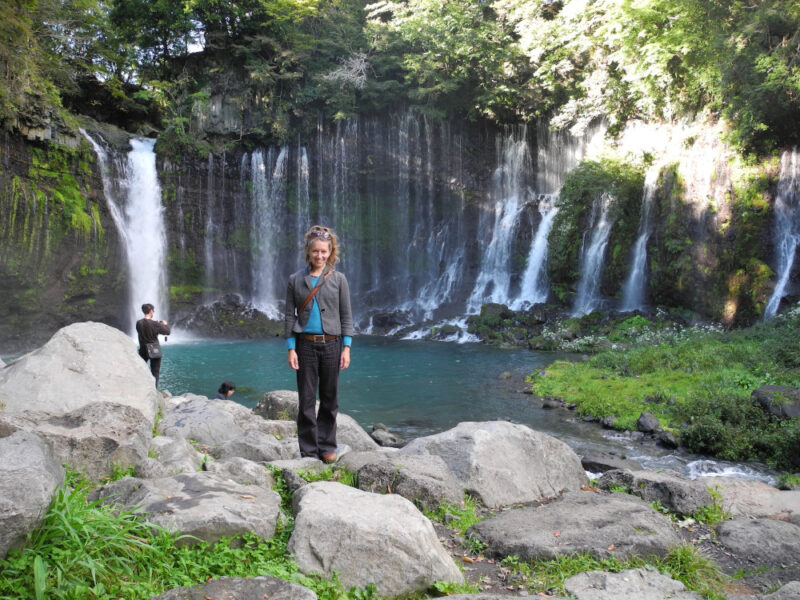
Shiraito no Taki

A turquoise-pooled paradise
in a bowl, a basin
hung with white strings

myself at Shiraito no Taki

Shiraito no Taki (‘waterfall of white threads’), Fujinomiya, Shizuoka, Japan
14th October 2014 (photograph by Uemura Katsuhiro)

whiteness

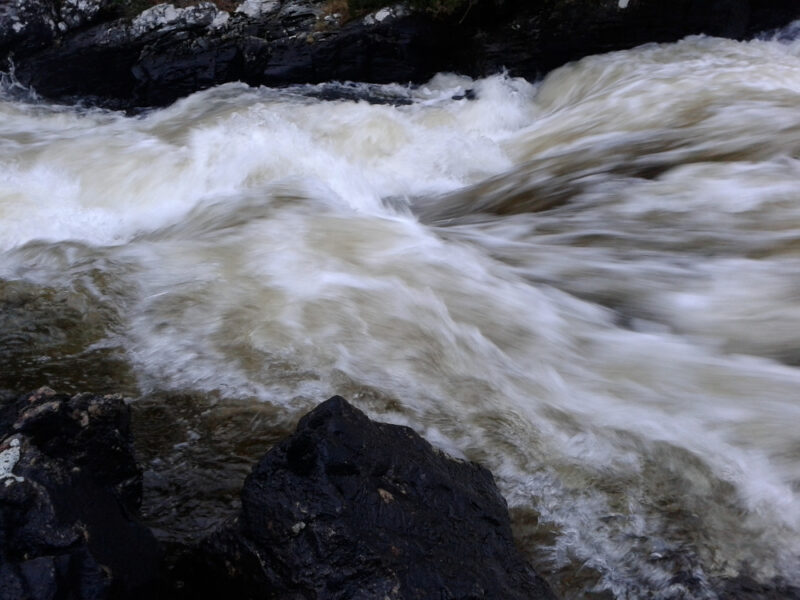
The whiteness of Scottish winters is on the go. Not held static with ice or slowly settling with heavy snows but moving: slim streams rushing down hillsides, big sea rollers whipping off into windy spray and blowing foam, sudden batterings of hail. Overhead too everything is in motion: thick white clouds scudding across the sky, the swift belly-white of the gulls fleering around beneath. When there is snow, it comes and goes; a dusting here, a gully-full there, before it’s rained out, wind-scoured, leaving only bleached stones and bones.

And the whiteness of Scottish winters is noisy. None of the soft muffling of snowfall or low creaking of ice. Our whiteness roars and rumbles: beaching waves, rapid rivers, the high clamour of waterfalls, the bright clattering of frozen rain. Scotland’s whiteness throws itself in your face and into your ears. It whips and lashes.

Even the elegant pale-limbed birches wave energetically alongside the running water, although occasionally you come upon the stillness of a white sea-washed stone resting silently at the head of the tide, cast up, waiting for the pull of the travelling moon.

white sea-washed stone

Assynt, Scotland
6th March 2014

by yon bonnie banks

Water is everywhere, pouring, rushing, pooling; the land is alive with water. White burns bubble through the woodlands on one side of the road; on the other side, trees are drowning in a wide field of water. It’s impossible to tell where the course of the river is or was – the whole field is flowing, and high on the hillside beyond it, huge falls roar where there were none before.

We’re safely north of Loch Lomond now, but as we wound round its banks, the loch itself was beginning to take its share. The outer half of the road towards Pulpit Rock had disappeared and road crew were there on built-out platforms rebuilding it – on stilts. It was a tight passage round the cliff there, squeezing between the water rushing down the rocks and the gouging maw of the loch.

As we come further north, the streams multiply. The steep hillsides are threaded by strings of white water and, as we approach Glencoe, the hills are scarred and scored in white. Snow fills each high crevice and ravine, highlighting the bare black bones of the rock shouldering through. Below the snow, streams continue the white lines, racing down the creases to the valley floors.

It’s not just the intensity of the water but its frequency that’s overwhelming. Each rock face is run over by a hundred slim streams. Even on the lower slopes and flanks by the roadsides, a new stream is gushing down every few yards, flooding the road and forcing us through ford after ford. Water is just pouring off the hillsides.

Water falling, water rising. And through the air too, great banks of rain move in horizontal gulfs. From safe inside the car, they almost feel sheltering, these great grey washes, engulfing us, until the wind harnesses them into harsh lashing whips. And so, through the water-ridden world we travel, sheltered and invigorated alternately, and all the while feeling secretly blessed by these thousand bright white streams.

Buachaille Etive Mòr, Glen Coe

Driving up the A82 (past Buachaille Etive Mòr, Glen Coe), Scotland
20th February 2014

lily

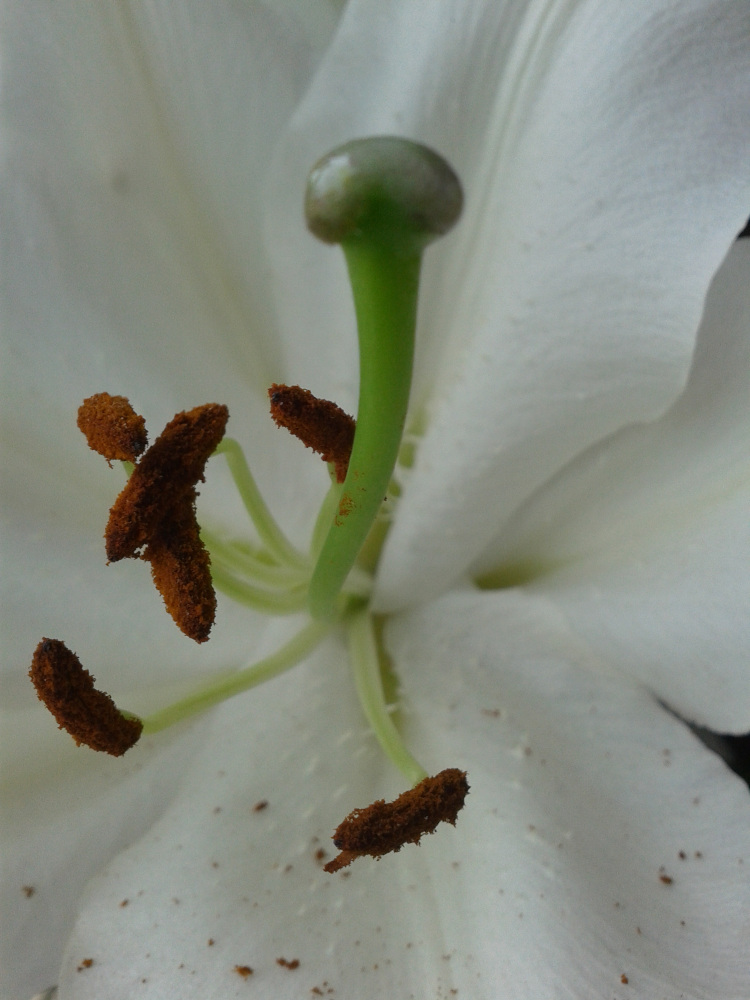
In the heart of winter, white lilies are exploding quietly in my rough-walled room. Anthers thick with pollen hang heavily around an erect glistening stigma, like lusty vulvas, scattering their russet dust everywhere. The sexes are reversed in this case, the stigma being the female part rising from the bulb of the womb. The petals and sepals peel back like inside-out labia, thrusting their sex shamelessly into the world.

Even just looking at them, I feel myself spreading open; and the scent, rich and heady and sensuous.

Oh, lily of the winter morning, lily of the winter warming.

heart of a lily

Pontycymer, Cwm Garw, South Wales
2nd February 2014

winter blossom

tree blossom

White crocuses poking through grass – the first flowers! A few steps later, pale blossoms leaning skywards on a tree. It’s raw out today though and doesn’t feel like spring: the winter is blossoming.

I’ve had white lilies in my room intermittently these last few months too. Despite their summer scent, they feel like winter flowers, opening secretly in the season’s dimness, and softening our hard stone edges in the absence of soft blooms of snow.

White flowers in the heart of winter. The crocuses look sort of virginal, like the snowdrops will when they bloom on the river banks beneath the trees. But lilies are obscene.

Walking by the Kelvin, Glasgow, Scotland
28th January 2014