interwoven
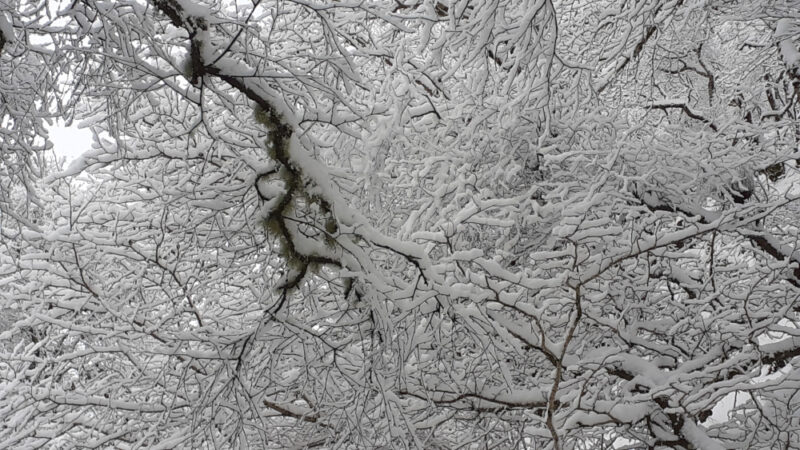
Culag Wood, Lochinver, Assynt, Scotland
5th January 2026
Culag Wood, Lochinver, Assynt, Scotland
5th January 2026
Heaven comes down to meet the earth in hard white balls,
sweeping curtains of swirling spheres,
bouncing as they strike ground, tree stump, woodpile,
gathering momentum as the wind strengthens
to form long battering blasts of horizontal hail—
the air whitens,
the sound against the caravan walls sharpens—
and then suddenly it’s quiet
and I look out to see
soft fluffy snowflakes
drifting gently all around us,
like benediction,
like a blessing for a new year.
Lochinver, Assynt, Scotland
1st January 2026
Unnamed lochan, Ardroe, Assynt, Scotland
28th June 2025

Burnet rose, Lochinver, Assynt, Scotland
21st September 2024
I see them every evening when I go to pull the blind on the side window of my caravan living room. Its frame perfectly frames them, hundreds of white flower heads crowding towards me in the half-light. Each one is a disc, itself composed of a hundred-odd tiny white five-petalled florets, and they seem to me like a miracle, these tall bustling blossoms which appeared all of a sudden this July.
I had to wait until they flowered to confidently identify them – wild carrot – and since the first one began to show its petals, they’ve exploded in number and inflorescence with new ones shooting up or opening almost daily. There are none in the immediate vicinity so they must have come from the native wildflower seed mix I dimly remember scattering in various parts of the garden a couple of years ago. There seems to have been no trace of them until this summer but apparently they flower in their second summer and the first summer grow a basal rosette of leaves which I do vaguely remember noticing last year. They’re a welcome surprise, if a bit bizarre, this lone stand of flowers bristling on the end of the low rise beside my caravan. They’re so high and gangly, they look a touch demented, a cubic metre of feathery flowery madness.
They come into their own in the dusk, their round white umbels like speckled moons floating above the settling darkness, seeming to hold a lucence of their own as the light from the sky seeps away. I stand and gaze at them, entranced, another moon face glowing through the glass. I often end up not closing the blind at all but settling myself down on the sofa beside the window and glancing out at them repeatedly as I write or read, enjoying their floral companionship in the encroaching night.
There’s something compelling about seeing white flowers at night. Once, when I was walking through the New Town in Edinburgh late in the evening, I came upon an arch of white roses woven over one of the gates of the private parks. I assumed there had been a wedding, and was so taken by the image that I carried white roses at my own wedding, in the deep cold of a Canadian winter a few months later.
Eventually the long winter melted, suddenly and rapidly, into summer, and as I struggled with the oppressive heat and blackness of the Montreal evenings, I took great solace in the night flowers. There were many, blooming forth from the tiny profusive gardens that lined the neighbourhood sidewalks, and I found them so sensual, just looking at them was a visual caress. The white ones captured me particularly, their pale blooms seeming to loom at me, almost leer at me, as I’d stroll past on my slow way home from the bar. I’d sometimes trail my fingers against them, the gentle touch of their petals cooling and soothing me as the humid air pressed stickily on my bare arms and calves.
Here, thirteen degrees further north and a few thousand miles east, the summer has been cold and windy and the south-westerly gales that have been battering us for weeks have pushed the long stalks of my carrots over so that they really do loom at me as I approach with my gaze. They lean in to me as I go to the window, and beckon me out, open-handed, into the night.
Lochinver, Assynt, Scotland
16th August 2024
It was a long walk in to the mountain, the red mountain so-called, though the stone was mostly weathered a silvery grey. Dark shadowed cliffs loomed up beside me as I wound my way up the glen, a bonny brown burn running beneath them, rushing over boulders and dropping off ledges in frothy white streams. At the foot of the steepest cliff, cradled in a corrie, lay a shallow lochan, its floor half-covered in soft weed which shone a gentle green in the sunlight.
I walked on, zigzagging up to the bealach below the summit, veering off the path halfway up to investigate a huge white stripe in the hillside which turned out to be a hefty vein of quartz. There had been lumps and flakes of quartz dotting the path and slim veins embedded in occasional boulders but this was a whole slab of quartz, a huge shelf of it. Big chunks lay broken loose beneath it, their edges razor-sharp as if freshly splintered. Indeed the whole mass of it looked newly formed, brittle and bright and clean. Its texture was slightly rough to the touch but shiny, like the glassy glaze of congealed snow.
I looked up at the cliffs beneath the summit ridge, which were close now. Another short stripe of quartz cut high up across them and on the grassy slopes above were slung a couple of swathes of snow. Eager for coolness on this hot day, I scrambled upwards, following the improbable stone wall which climbed from a lochan on the bealach straight up the side of the hill almost to the summit before turning neatly to the right to run above the cliffs. As I ascended, the mountain reddened, the grey rock underfoot giving way to a peachy-orange tint where the stones had been disturbed or the ground worn by footfall. I understood its name now but it was the whiteness which most compelled me and after resting at the summit cairn, I headed back to the wall, clambering over a gap to take a handful and mouthful of snow.
Refreshed, I continued alongside the wall. Well-weathered and evidently very old, it was in remarkably good shape, six foot high in stretches and running for several miles with only occasional collapsed sections. I marvelled at it as I followed its seemingly endless length down the westward spine of the mountain: a single skin construction of large heavy slabs stacked mostly vertically; huge slabs, although they wouldn’t have had to carry them far given the boulderfield the wall ran through. I held onto the wall frequently for physical and moral support as I picked my down the horizontal maze of prone stone until finally it ended at a rusted iron fence post, and I scrambled and slid down the steep heathery slopes to join the path again.
Covered in sweat and mud and presumably ticks, I looked for a place to cross the burn and came upon a little scooped pool where the water settled before tipping over a smooth lip. Sheltered from almost every angle, I stripped off and slipped in, letting the water lap over me, soothing my heated, scratched skin as the evening sun slid slowly down the sky.
I watched the white froth of the water entering the pool and felt with my foot the small vein of quartz that flowed through the pool’s floor, and thought of the snow, the memory of it cold on my tongue. What height, what whiteness! If the summit was the peak of the walk, this was its delicious denouement. And yet it was when ambling back down the path and re-entering the forestry plantation at the foot of the glen that I was most utterly enthralled.
To my right, amid the tall conifers, was a walled enclosure. Small ruined buildings edged its southern side but the wall itself was mostly intact and held a small field almost entirely carpeted in bluebells. I walked in and stood in a small clearing in the centre. The sun was leaving and in the cool shadow, the colour seemed to hover, scented, in the air.
I stood there for some time, a contentment settling upon me, and such a sense of peace, of deep blue peace. I could have stood there forever. All the glories of the day gathered there in the evening light, in the frilly blue haze, which was punctuated here and there with small patches of white. I wondered what the white flower could be but on looking closer discovered it was clutches of bluebells, pure white bluebells, the tender curls of their living flesh breathing in the field with me, the softest and finest of all the day’s treasures.

Beinn Dearg, Loch Broom, Wester Ross, Scotland
15th May 2024
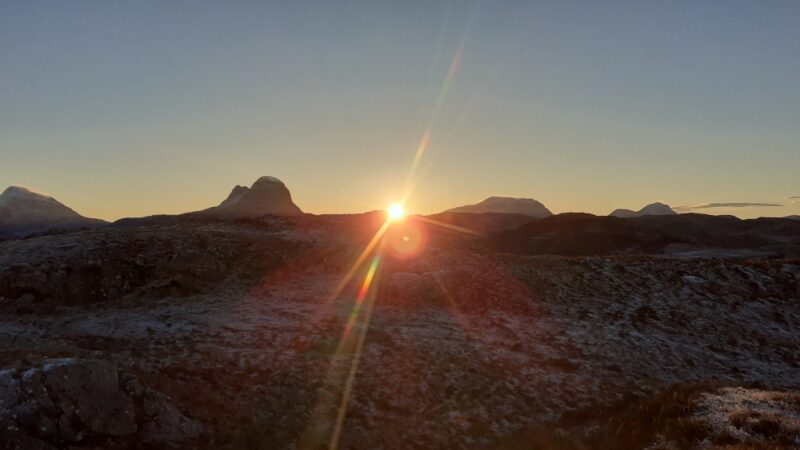
The sun touches on one mountain, then another, their glowing faces like a sundial indicating the sun’s unseen path around the Earth. It reminds me of the nights I spent on the island of Værøy in northern Norway one summer, watching the sun move across the upper edges of the mountains arrayed to the north. In that case, the moving light marked the hidden passage of the sun across the northern sky. Today, down at 58° north on a hill at the back of Lochinver, the sun is about to rise in the south-east.
I keep watch.
First the south-facing flank of Sàil Gharbh on Quinag lights up, to the north-east. Then, further north, the snow-scarred heap of Ben Stack. Just beyond, the sides of some of Foinaven’s spurs begin to shine, the whole undulating wave of the mountain beautifully, completely, covered in snow. Next, it’s a tiny scrap of cloud clinging to the back of the long ridge of Canisp, to the south-east.
As with the midnight peaks of Værøy, the sun gives the rock a warm red-orange hue, like glowing embers, yet it’s a haphazard sundial here, the strange angles of the land and the long distances between the mountains meaning illumination isn’t always coming where I expect it. Now, on the rough moorland between here and Quinag, a small scooped rise is picked out in gleaming russet, everything around it remaining in frosted brown shadow. Then, to the south-west , on the Coigach peninsula, that wee knobbly hill at Achnahaird suddenly brightens.
I look westward. Across the Minch, the Long Island is reddening, its foreshores rosy below snowy peaks. The long line of clumpy cumulus clouds which sits above the island, skimming the high tops, shines softly, and above those, a half-moon hangs chalk-white in the pale blue sky. Between the clouds and the moon, the sky, which was deep pink, is turning a limey yellow.
Back on the mainland, the upper edges of the moorland in the north-west are beginning to glow. The horizon in the south-east is a pale dense yellow, the huge bulk of Suilven standing blue in its centre, its tall humped head a sentinel, a watchtower. To the right of it, the angular silhouette of Cul Mor is backlit. A cold wind blows out from them, rising with the light.
I keep watch.
The sunlight on the north-western moorland inches infinitely closer. I can see the headlights of a car over there at the viewpoint, now in sunlight. I can also, through my binoculars, see a few ships illuminated out at sea, their bright white floodlights, like the car headlights, seeming puny and fake in the slowly flooding dawn. A pink-red freighter is passing on in front of the red cliffs of the Shiants, a lurid fuscia colour against the rich blue water.
And now it comes, the sun, on the high ground between Suilven and Cul Mor. It appears at first like a tiny gold star, then a curve, then a full face of nuclear radiance. I’m dazed a minute, sun-struck. The wind picks up even more so that I’m actually colder. I look around and suddenly all the colour’s gone. The clouds and the snowy mountains are all just white. The freighter, now north of the Shiants, is dull red, while the island cliffs and foreslopes are brown, as is the tussocky moorland all around me.
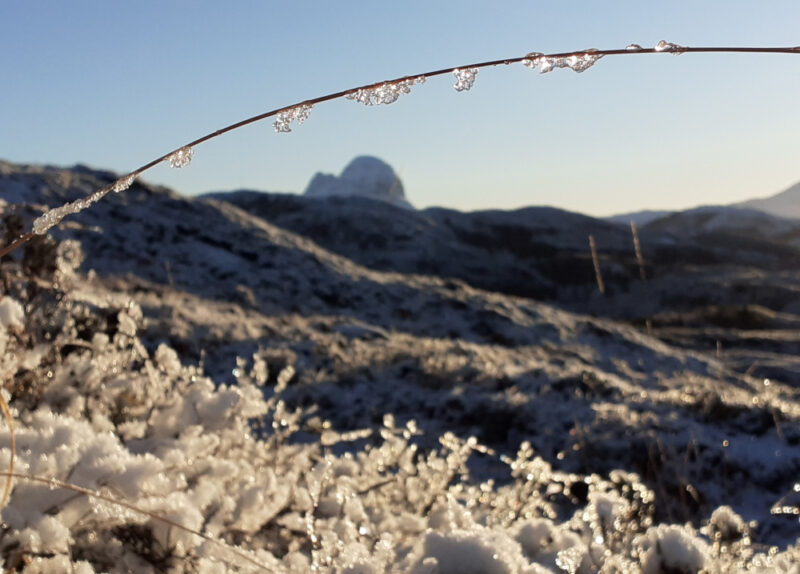
I pick my way back across the frosted rocks and frozen bog to the road and walk back, downhill, into shadow. The air is still again but the cold is deep and damp. The small roadside trees are so thickly coated in frost they look snow-covered. I wind my way into the woods behind the harbour. Here, the frosted twigs and branches form a latticework so dense that from a distance it looks like smoke. Occasional beech saplings hang onto their crinkled orange leaves, like mysterious clootie trees. At the edge of the woods the broom has grown so tall that it curves over my head like exotic white palm trees. It’s all very surreal. My mind almost can’t believe what it’s seeing, as if it’s frozen in suspension, chilled into stillness.
I walk back round the head of the loch, through the village. The frost growing on the grass on the wall of the playing field is so thick that the ice crystals must be at least half a centimetre long, giving the blades the appearance of being furred or feathered. I run my thumb and forefinger up their length, feeling the tiny shards fall off, cold and almost dry under my skin. I imagine I can hear them tinkling as they fall and it suddenly seems so intimate. I notice a young man walking towards me and feel almost embarrassed to have been caught in such a flagrantly sensual act. I can’t help it though and I carry on after he has passed, this miniature crystalline delicacy a compelling contrast to the solid heft of the mountains, yet all held equally fast in the strong stiff cold.
Lochinver, Assynt, Scotland
3rd December 2023

I pull out of the layby and head north. After a hot and sweaty day’s hill walking on Cranstackie and Beinn Spionnaidh and a muggy night in the van, I’m ready for some cold salt water. The flat gold sands of Ceannabeinne beach hover alluringly in my mind as I drive up the side of Loch Eriboll, but after only a few minutes I’m compelled to pull in, as my eye has been caught by the wall at the entrance to Lotte Glob’s sculpture croft. I walk over for a closer inspection. It’s a graceful wall, smooth and neat, and as it slopes evenly down the steep bank on each side of the gateway, its vertical coping stones form an elegant slanting line. Most striking of all, it’s built entirely from quartzite and its soft pink and grey tones give it an almost tender aspect.
I think it’s the most beautiful dry stone wall I’ve ever seen. I’ve been paying a lot more attention to walls since I started learning how to build them a few months ago. I work in Assynt, rebuilding old walls which have fallen into disrepair, so am usually working with Torridonian sandstone and Lewisian gneiss, the two main types of bedrock there. There’s the odd lump of quartzite – which is otherwise mainly found on the area’s mountaintops – but not much, which is a shame as it’s my favourite type of stone. Indeed, it’s the reason I’m up here. Beinn Spionnaidh and Cranstackie are comprised almost entirely of quartzite on their eastern sides, and I’ve had great fun walking and scrambling over their extensive boulderfields.
I get back in the van and continue up the loch. There are a lot of walls here and I notice now that they’re all quartzite, lichened and weathered grey over time, but still subtly luminous and clean in their lines. I’d love to build a wall out of quartzite. It’s such a stylish stone with its crisp edges and rakish diagonals. It’s also the easiest of the rocks I’ve worked with to dress, splitting nicely and yielding lovely sharp wedges.
Maybe one day I’ll get work up here. For now, I’ll get to the beach and soak my tired feet and wonder about the older coasts I have just been walking on. The quartzite here is a type of quartz sandstone which was originally laid down on a sea shore about half a billion years ago. Some of it, the pipe rock of the summits, contains fossilised burrows of ancient sand worms. It’s hard to imagine the age of the stone that passes through my hands and under my feet these days. My impending half century is nothing in comparison. I’m a bubble of froth on an incoming tide, a feather falling from a bird’s wing.
Entrance to Lotte Glob’s croft, Laid, Loch Eriboll, Sutherland
18th June 2023
Loch na Creige Léithe, Assynt, Scotland
16th June 2023
Suilven, Assynt, Scotland
12th December 2022