eclipse

The worlds line up, the moon slides between us, the sun shrinks to a slim arc: angelic when viewed through blue glass, apocalyptic when seen through red – a devilish smile hanging in the sky, which thins and grins and swells.

I wait the full cycle of a clock-face for the swelling to continue, for the sun to become full again, for the moon to sidle off to the side – and disappear!

I wait, feeling the heat grow measurably on my face, and watch, because I have to; because I am a human, in this circling system; another body bound to the sun.

Cwm Garw, Glamorgan, South Wales
20th March 2015

Letter from Lanzarote

I sit under cool calm clouds – greyish and soft and medium weight – and watch bright white lines forming and diminishing out on the flat grey surface of the sea. The lines are new. Before they appeared, a whole patch of sea was blazing, as if the finely rippled surface had been fused into a plate of sheer platinum. Then, as the sun retreated towards Africa, the plate dissolved and the lines appeared. They shine, elongating and contracting, only near the horizon. Some of the lines are small and such concentrated white that they look like the foam of tiny distant breakers. However, the surrounding sea is too flat and peaceable to generate such froth and, although the lines change in size, the whiteness itself holds and doesn’t fold in.

If I could bear myself that brightly for so long –

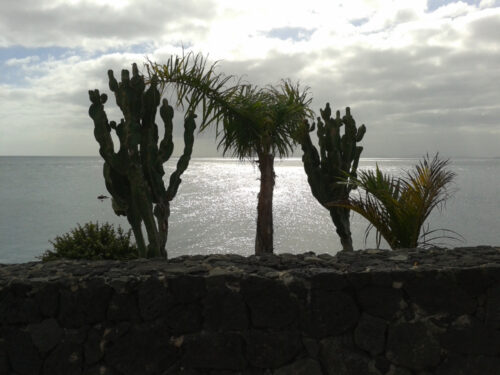
palm trees silhouetted against a sun-shone sea

Puerto del Carmen, Lanzarote, Canary Islands
2nd February 2015

Tokyo

There’s a lot of vegetation in the quieter districts of Tokyo and, since the streets aren’t named, and since most of the buildings look similar, I rely on the plants to navigate and find my way around. They become familiar: the pink flowering tree, the green fluffy maple with its leaves like a thousand tiny hands, the tall red-turning hedge, the pale green conifer with soft feathered claws hanging.

The trees are distinctive here, thankfully, and exotic. And they seem to grow to suit their district. Twisted Japanese-looking pines predominate in the small stone household courtyards, often pruned and wrapped into bonsai-like shapes, but in the backstreets of the bustling bright district of Shimbashi, I found a shrine complex where the trees rose almost as high and straight as the skyscrapers surrounding it.

The numerous trees in Tokyo are a pleasant surprise to me. The other surprise is the multitude of hidden shrines, tucked away in the corners of parks, in back alleys, between skyscrapers, behind trees. They’re little pockets of peacefulness and I seek out their solace regularly. I feel strangely reverent and slightly magical in their presence, as if I’ve slipped back in time a little and can become part of the ceremony and power of the shrine. It’s a simple ritual: offer a coin, make a prayer, toll the bell, clap your hands, twice (to wake up the gods), then bow and quietly depart, having washed your hands and mouth in the spring water fountain before entry. Old rites of purification and desire.

And then I can return, when I must, to the crazy Tokyo – to the long downtown streets lined with neon rainbows of high-rises, or to the weaving maze of backstreets, crammed with tiny restaurants and micro-bars, bathed in the softer glow of paper lanterns and a haze of smoke and cooking smells.

I walk and resist, walk and resist, enjoying the myriad lights of the outdoor Tokyo, until I am lured by necessity into the network of metro stations and malls, where I force myself to submit. Then I drift hopelessly along the fluorescent platforms and passageways, with their shining shops and beckoning kiosks and high female voice-overs which explain and apologise and cajole. No electricity is spared here. And I could become part of it, become just another pixel in the smooth lighted buzz… but every few minutes I’m jolted out of my synthetic reverie by another taut announcement, with its childish melody chiming loudly along beside it.

Ah, Tokyo. It panics and charms me by turns, and I can’t wait to get out.

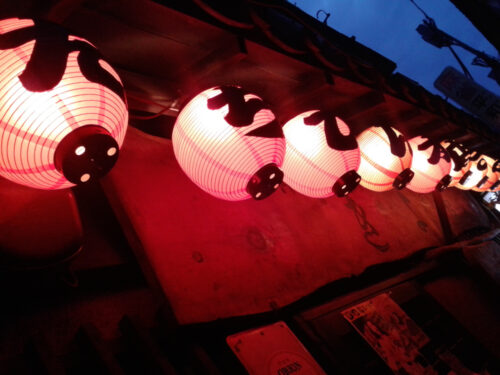
paper lanterns and red lights

Tokyo, Japan
29th September 2014

Yes

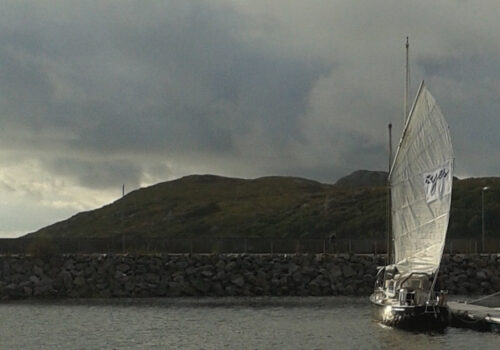
The flag flaps indifferently outside. You wrote your hope on it and you raised it on the sail for good measure: the affirmative doubled, and reflected twice in the still sea that surrounds.

The polls are perfectly balanced. Tonight the tide rose as the sun set and in that moment of golden fullness, you wished that it all could hold itself, poised here; your country’s hope as buoyant as its doubt, spreading out on this wide blue salt mirror.

But the sun set, the tide drew out, and you had to fold in your sail as the moon sailed up instead, round and full and sure of itself in the high and silent sky. If the glow would grow, if the people would assent, if this time turning will be for the best, if we will all say yes –

Ara' Deg mainsail raised with 'yes' banner pinned to it

Lochinver harbour, Assynt, Scotland
14th September 2014

rowing

I go for rows most of the days when this loch of the river mouth is relatively calm.

I row partly because each day I need to look at the horizon. Some days I want the height of the headland or the boulder-piled breakwater and the prospect of Harris and Lewis rising a little higher. However, other days I want to be on the same surface as the horizon, to be level with its elongating distance, the flat bottom of our tender licked fast to its constituent sea.

The rowing also has the purpose of holding my nerve. Since we’ve been docked on pontoons all summer, indirectly land-tied, I miss living at anchor and fear I’ll lose my hard and slowly-won ability to row solo on the sea.

My rowing ritual isn’t grand. I untie myself from our floating dock, push myself out from the sheltered pocket of water behind Ara’ Deg, slide the oars into the oarlocks, plash quietly round the last finger of the pontoons, and ease out alongside the breakwater. I keep an eye out for any large fishing boats that look like they might be about to head out, or fast ribs, which make big wakes which scare me. But all the same, while I’m still in the harbour, I am in man-made shelter – until I work myself round the end of the breakwater and into the pull of the open horizon.

This is the turning point, where I feel us – the boat and I – rock as the ripples of wave or rib or fishing boat reach us, where I feel the breeze rise and ruffle, feel the tide ease us back or on.

I adjust our direction and pull straight out to sea for a few strokes, veering slightly north-west or south-west to be riding directly into the wind, if there is any, keeping perpendicular to the line of waves to take the rise under our bow and avoid being rolled side-on. Then I steer us round the back of the breakwater, out of sight of the visual security of the harbour.

Now I am alone with the horizon, held between the long-ridged arms which hold it out afar. A couple of small humped islands hover at the mouth of the loch and beyond those Harris and Lewis sometimes float on the other side of the Minch. I stare out and attempt to read the horizon, attempt to absorb and understand whatever lies upon it. And then I just sit, or bring in the oars and lie back on the steady lilt of the water, closing my eyes or gazing skywards, letting myself drift in this rolling sheen between the sea surface and the underbelly of the sky.

I never rest completely, my mind taut with watchfulness and fear of the water. And after a little time I rouse myself, rise, dip the oars back in, and turn us around to row back, watching the horizon close gradually with each small stroke, relieved and sad to be returning.

This ritual is always the same and always different. Sometimes the whole sea is sunny, like an open blue field. Other days it is closed, distant and grey. Today it was cloudy where I sat and swayed and drifted but the clouds were shifting and splitting and, further out, a bright patch of water lay under the sun, broken by the wind into shimmering speckles of light.

Looking at it filled me with an acute longing. It was irresistible: a glad glimmering, a golden gleaming, a meadow of heaven cast to the surface of the sea… so I rowed towards it but it was impossible to reach. As I approached, the scattered glimmers widened to slim liquid lines, sliding along the ridge of each rippling wavelet. Even as I felt the sun on my face and arms and knew I had arrived, the flickering shimmers receded and receded.

It’s always further on, you see; it’s always further on.

Loch Inver, Assynt Sutherland
2nd August 2014