garden
Always a new treasure to be discovered
in this secret garden of a city,
in this living labyrinth of a life.

Archivist’s Garden, Register House, Edinburgh, Scotland
21st May 2018
Always a new treasure to be discovered
in this secret garden of a city,
in this living labyrinth of a life.
Archivist’s Garden, Register House, Edinburgh, Scotland
21st May 2018

the little white sakura of Scotland
a taiko heart beating beneath the blooms
On The Corner studio at The Space, Glasgow, Scotland
6th May 2018
droplets and shadows
in the shelter of the sunlight
Cwm Garw, Glamorgan, South Wales
20th April 2018
It’s always leaving, that’s what this sailing life is. It’s making a fresh friend and then casting off the lines that tie you and drifting away into the dawn.
I love so much, that’s my problem. I moor myself readily to each new dock in each new harbour, my heartstrings and dock lines pulling tight in the wind. And then we’re off again, your unattachable heart merrily seeking the next temporary destination while I’m still trying to undo the knots I’ve looped myself ashore with. And it’s not just people I grow fond of: the rounded hills at the mouth of the loch across the sound, the sudden misted glows in the sky behind the boat yard, the night-time curve of the village lights around Marine Road… And that grey-cloaked heron croaking by each eve, and the wee rock pipit flitting from deck to deck in the mornings, and the eiders which are always paddling about, calling to each other in incessant gulps and gargles.
So now, at the end of another winter’s berthage, I’m brimming over like this bay at this high tide. I used to be a solitaire, but there’s something about these groups when you find them – the friendly marina crew, the happy gang of harbour staff, the quick communities of sailors sharing docks and drams – all these sea friends and shore friends; all this coming and going in my heart.
Port Bannatyne marina, Bute, Argyll, Scotland
11th April 2018
The Beast from the East is washing up roses; yellow roses, long-stemmed and fresh. They lie in front of me on the shingle shore, a bit battered but still intact, their damp petals closely furled and gently tinged with pink like cheeks flushed from the cold.
Where have they come from? I look around to the snow-covered hills behind and then back to the growing wildness of the sea ahead. It seems so improbably, to be standing here beneath all these white-capped waves and hills and find damp yellow petals at my feet, but here they are. I stare at them more closely. Their tender colour is vivid against the dark wet stones and, in this monochrome world, their presence makes everything else look even more black or white.
And I can’t decide which is whitest: the froth on the waves as they spill over, scalloping the shore, or the fresh snow lying in crystallised lines among the pebbles, or the smoothed fragments of quartz, or the plump breasts of the eiders paddling out into the wind, or the lean bellies of the herring gulls soaring up sideways in the stiff air, or the blanketing cloud pushing in briskly overhead, or the pure white disc of the sun within the cloud, sometimes dropping a cold platinum glint on the grey water, other times bestowing a soft sheen which rises on the slow westering swell before casting itself graciously on the shore.
I can’t decide and it doesn’t matter as I stand here before this shone water, before this powerful sea turning itself over with a glancing tenderness at my feet, softly smashing on the shingle like crumpled petals, like flung roses washed clean.
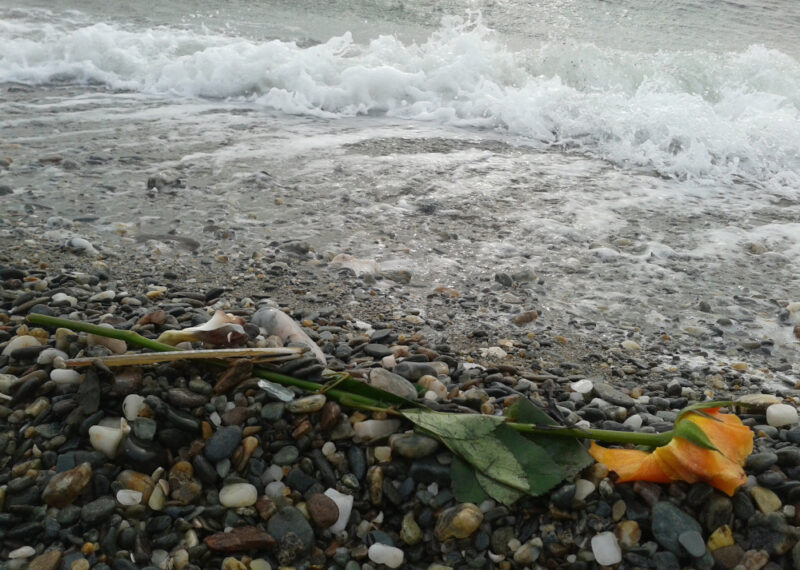
West Bay, Dunoon, Argyll, Scotland
28th February 2018
cold sea, cold sun,
Arran hidden within a vanishing haze,
shining sands evaporating invisibly
Ettrick Bay, Bute, Argyll, Scotland
23rd February 2018

Queen’s Park, Glasgow, Scotland
2nd November 2017
A great grey roll of cloud lies over the mainland. Over the island, the noon sun is salmon-red, sidling eyewards in quick glimpses between snowballing white clouds. The boats are rolling about, lurching in their berths, jerking as the lines tug taut, as the wind stiffens and rises.
It’s hard to take a wind with a human name seriously. Yet Ophelia excites me, fraying my nerves to a quiet frenzy as her wheeching whine conducts itself through sixty-odd riggings. The noise builds in a strange sheer crescendo. The motion builds too, the boat becoming increasingly restless in her cramped quarters, straining at her moorings, sending my heart shuddering in its hull with each jarring heave. She wants to be released, wants to ride herself free on this great gusting abandon. And I do too, though instead I keep holding on, obsessing over our lines, loosening and re-looping them repeatedly as I try to find the perfect balance – enough slack to have room to move yet enough tension not to stray.
Oh, but it’s tempting – although in this wind we’d be on the shore before we had time to raise even the head of the sail. Patience, I tell myself. It’s not time to cast off yet. It’s not time to let go.
Port Bannatyne marina, Isle of Bute, Argyll, Scotland
17th October 2017
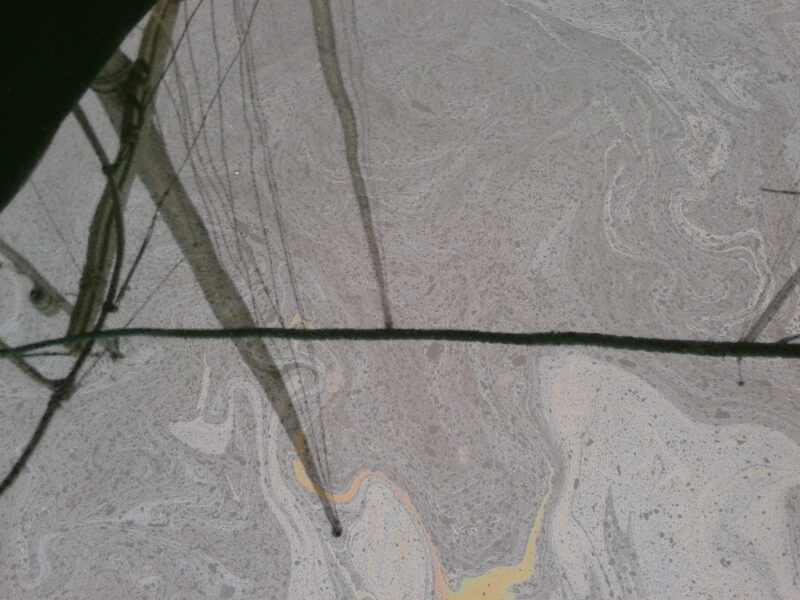
Port Bannatyne marina, Isle of Bute, Scotland
15th October 2017
Autumn leaf fall
– with such intent
Cwm Garw, Glamorgan, South Wales
29th September 2017