Nantai-san

Nantai means ‘man’s body’ and the body of the mountain is varied. I climb through tree roots and torii (shrine gates), clamber over boulders, and slip on muddy sand and sharp rubble. The mountain is a volcanic cone, much like Mount Fuji, and it is a sacred mountain, a shintai, something which holds kami, spirits.

The path to its summit is difficult yet popular. By mid-morning, I’m meeting many elderly Japanese who are already on their way down, and several younger (middle-aged) men. The latter are dressed all in white, the colour traditionally worn by mountain pilgrims and the yamabushi, the mountain ascetics who lived here in earlier centuries.

Whiteness appears regularly on the path. The torii at the foot of the mountain, which I passed through to ascend, were dressed in strands of straw rope and hung with the folded zigzags of white paper which indicate a sacred place; and beside the path white plastic strips are tied around occasional tree trunks at eye level.

As I make my way up, I also start noticing fine curls of pale birch skin lying intermittently beside the trail. At first I pocket them as miniature mementos then realise they’re too regularly placed to be chance arboreal sheddings, and start myself dropping them along the way as I continue. The trees themselves are changing as I get higher and white birch trees become more frequent until, at the edge of the trail, on a steep curve of the mountainside, stand a line of them, their loose peels of bark unfurling, and as the breeze catches them, they flutter in the sunlight like the paper strips on the torii.

At a tiny shrine set into a rock face a few hundred feet short of the summit, the birch disappear completely, and the world becomes comprised of twisted pines, bleached dead limbs and stumps, and reddish volcanic soil. A sudden cold wind arrives and, as I climb, the trees and soil finally give out until there’s only sharp lumpy black and red rock, and a steep open rubble slope to the summit.

It’s a surprisingly difficult scramble up but, along with the old lady who’s appeared beside me, I get there. The summit is graced by one main shrine and two smaller ones, and I find a sheltered place to nestle by one of these subsidiary shrines, on the far end of a ridge slanting off to the north.

Lines and lines of blue hills rise and fall into the haze of the western sun (Fuji-san hiding somewhere to the south) and the north is full of steep peaks pointing and spearing the mat of thick grey cloud above them. I’m sitting behind some lumpy black rock, having daifuku (sweet red bean patties) and green tea, when I notice tiny white particles drifting around me. At first I think it’s tiny flies, then I think it’s dust, then I’m sure it’s ash, then, as a tearing wind sets in, I realise it’s snow. I barely get back across the ridge and down to the treeline. The wind is like walls of ice, scouring and freezing. I have never been at this altitude before. The world whitens, sharpens. I am blown away!

Shinto Torii gate at top of Nantai-San

Nantai-san, Nikkō, Tochigi, Japan (2486m/8156 feet though I start from Chuzenji at 1269m/4163 feet)
17th October 2014

Fuji-san

Rising naked at dawn
gathering a soft shawl for the morning

At sunset
held aloft on a shrug of rosy white cloud

Fuji-san from Fujinomiya

Fuji-san from Fujinomiya, Shizuoka, Japan
14th October 2014

morning

Leaving in the early morning,
moisture rises off the rice fields,
the blue ridges of the mountains dissolve.

Fukui, Japan
9th October 2014

glimpse

South west out of Tokyo the road unravels, from the gridlock of skyscrapers, through scattered suburban sprawl, and down and out towards the mountains, rising like blue waves ahead.

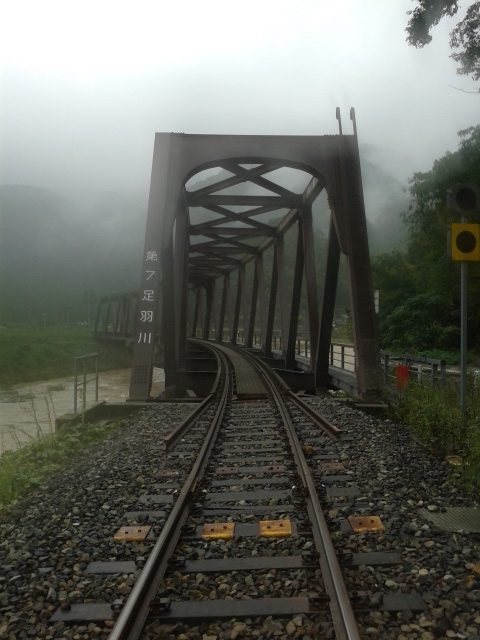
The hills look young, sharply ridged and thickly wooded, bridges like scaffolding bracing their narrow valleys. The road winds beside and between them, beneath groves of yellowish bamboo fanning their slopes like giant feathery ferns, and intermittently crossing turquoise-green rivers which slide out from the valley floors.

Japan is either steep or level. Where the hills stop, the plains start, and the rivers then meander slowly across them, between yellow rice fields and grey cities, out towards the shining pacific sea. The road veers out from the mountains to follow them, and before long we are rolling alongside the flat southern sunshine of the ocean while the land concertinas away – like a dream – in fading blue folds to the north.

*

first glimpse of Mount Fuji above the mountains
   hanging flat
      like a ghost or a backdrop brushed in palest
                                              (almost transparent)
                                                                                   blue

Bus from Tokyo to Fukui, Japan
1st October 2014

Suilven

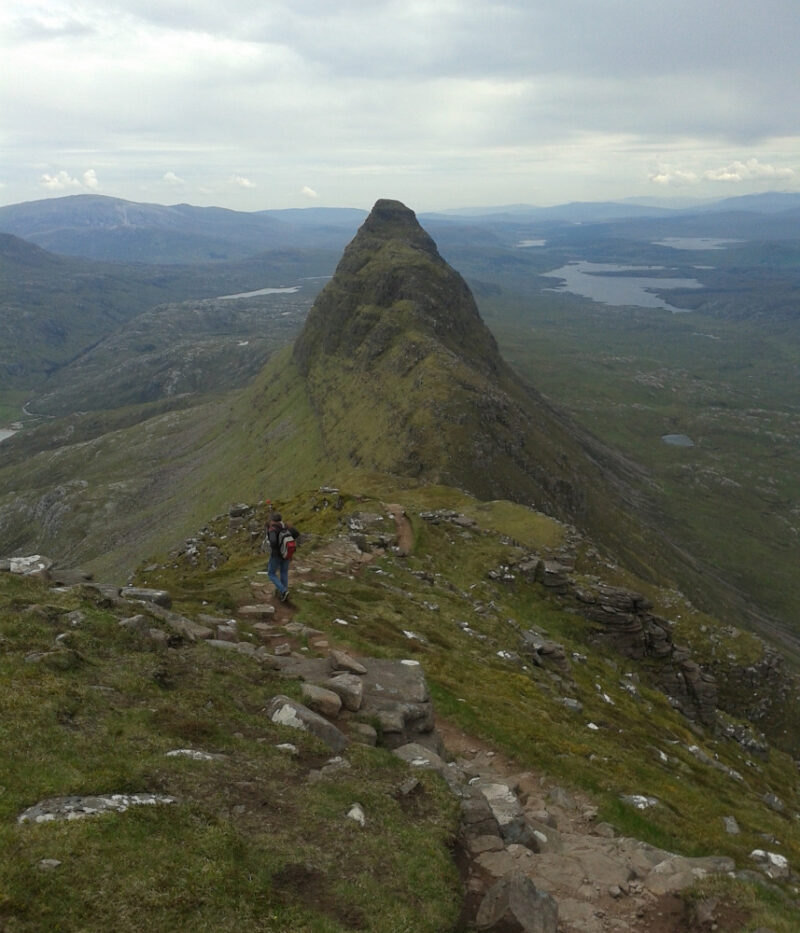
Suilven is looking at me, or at least that how it feels lately. Everywhere I look, I see it. Each morning when I poke my head out of the hatch, from our boat on the floating docks in Lochinver harbour, there it is; in sunshine, green dome gleaming; other times swathed in summit-crawling mist. Often its domed top is sliced off completely by cloud but it’s even more ominous then, its threatened presence looming larger than its actual visual spectre.

I stalk it back, from the safe distance of this far end of the harbour, preparing myself for the day I will climb it. From this side it looks impossibly steep – pillar mountain, Sula Bheinn – a rock hard phallus of vertical ascent. Locals assure me that it’s the long walk in rather than the climb up that is the hard part. However, this afternoon when I looked at it through binoculars I was actually frightened.

I was slowly scanning the horizon above the village, my eyes grazing, leisurely following the patches of light which were moving sensuously over the tilted scree slopes of Canisp, and then onto the lumpy moors with their little woodlands and clearings of soft grass, all greenly idyllic. And then suddenly Suilven – filling the view, filling the world.

I have to admit, my belly shuddered a little, my heart quickened and quailed. Suilven so close. And I am to scale it…

Lochinver harbour, Assynt, Scotland
17th May 2014

by yon bonnie banks

Water is everywhere, pouring, rushing, pooling; the land is alive with water. White burns bubble through the woodlands on one side of the road; on the other side, trees are drowning in a wide field of water. It’s impossible to tell where the course of the river is or was – the whole field is flowing, and high on the hillside beyond it, huge falls roar where there were none before.

We’re safely north of Loch Lomond now, but as we wound round its banks, the loch itself was beginning to take its share. The outer half of the road towards Pulpit Rock had disappeared and road crew were there on built-out platforms rebuilding it – on stilts. It was a tight passage round the cliff there, squeezing between the water rushing down the rocks and the gouging maw of the loch.

As we come further north, the streams multiply. The steep hillsides are threaded by strings of white water and, as we approach Glencoe, the hills are scarred and scored in white. Snow fills each high crevice and ravine, highlighting the bare black bones of the rock shouldering through. Below the snow, streams continue the white lines, racing down the creases to the valley floors.

It’s not just the intensity of the water but its frequency that’s overwhelming. Each rock face is run over by a hundred slim streams. Even on the lower slopes and flanks by the roadsides, a new stream is gushing down every few yards, flooding the road and forcing us through ford after ford. Water is just pouring off the hillsides.

Water falling, water rising. And through the air too, great banks of rain move in horizontal gulfs. From safe inside the car, they almost feel sheltering, these great grey washes, engulfing us, until the wind harnesses them into harsh lashing whips. And so, through the water-ridden world we travel, sheltered and invigorated alternately, and all the while feeling secretly blessed by these thousand bright white streams.

Buachaille Etive Mòr, Glen Coe

Driving up the A82 (past Buachaille Etive Mòr, Glen Coe), Scotland
20th February 2014