dojo

I am folded within the green mountains of Miyama. The weather is warm. A light rain has just fallen, diffusing the thick wall of cedar-green foliage that fills the window. We are in the Kurumaya Taiko Dojo. Dojo means ‘the place of the way’ and it is a beautiful place: a large high-ceilinged low-windowed room with a warm hinoki, cypress, floor. The walls are wood-panelled as well, and hung with prints and scrolls of Kurumaya-sensei’s calligraphy, and photographs he has taken of Miyama in snowy and summer seasons.

It feels very natural to be here, perhaps because the room itself feels natural, perhaps because natural elements gather here. It is a room made of wood and paper after all, and a room made of skin, with taiko, drums, lining all its walls.
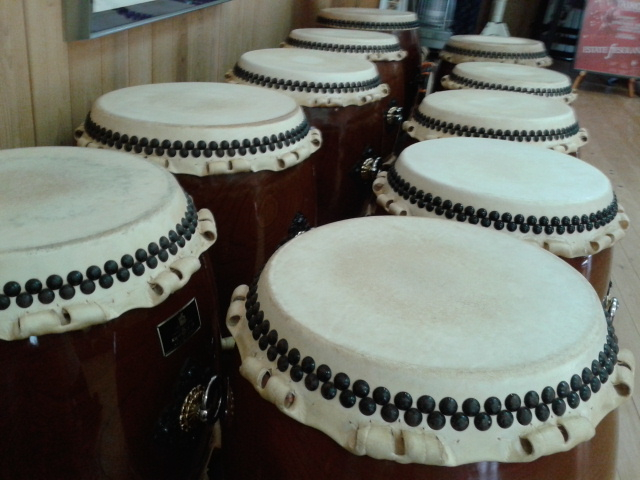
Asano nagados

There are taiko of many forms and sizes – small taut shime and little hand-held uchiwa fan drums, as well as huge uchiwa, and an odaiko (‘big drum’). There are also several light barrel-construction okedos and – my favourites – rows and rows of nagado, ‘long-bodied’ drums made from one piece of hollowed wood with the skin tacked tightly around.

The skin of the taiko is cleaned cow skin and the room reverberates with it as we draw the drums into a circle and, pulling our own skins taut over our muscles, beat and sweat and beat.

Out the window, beneath the green cedars, the mineral-blue river gurgles slowly along the valley floor. Above it, just visible in the rock of the facing mountain, are three little stone Buddhas. They sit all day long, as we come and go, in their fading red bibs in their little hand-carved holy place. It’s good to have a home.

Asano shime daiko

Kurumaya Taiko Dojo, Miyama, Fukui, Japan (taiko made by Asano Taiko)
8th October 2014

on the hard

Ara' Deg on the hard

Our boat is out of the water now and we live poised on a slim keel. Winds bring a subtle rocking motion as our fibreglass hull shivers and flexes on its stand, and my mind invents or imagines more movement, having accustomed itself to living in the slow shudders of the sea.

All my instincts tell me it’s unnatural to be perched up here, high and dry, set on a slivered wedge of fibreglass and ballast, held up by five thin metal supports. We sit on reclaimed – or recreated – land too, a concrete boatyard filling in what used to be a fine sheltered curve in the bay.

I can see the water from here though, pale under the night sky beyond the fishing boats and harbour wall; and across the loch, behind the lumpy hills, the bright rose of the northern sunset glows steadily. Suilven rises on the other side of us, a visible lump in the starboard portlites, marking our position here, on this concrete plain between the hills and the sea.

Its presence eases my disorientation and as I get my bearings Ara’ Deg slowly starts to become a home again. The streamlined bulge of her hull shelters our rusty bike and the tools for whatever boat job we’re currently working on, and there’s space for our car parked neatly beside. Hoses and electrical cords wind their way across the yard to her various openings, and we fix and clean and paint her, in anticipation of her saltwater return.

Ara’ Deg herself seems to be in no rush though and, as she adapts to her new surroundings, they adapt themselves to her. A hooded crow took up position first, cawing loudly from the top of the main mast our first morning here, and a collared dove sat calmly on our lifelines for a while one eve. This afternoon I found a sparrow clinging to the rope I had tied to the halyard to stop its blocks clanking against the mast, and swallows are constantly zipping around us in graceful forked swoops.

From up here I can also see – and hear – more of the five raucous herons which nest in the crowns of the conifers atop the rockface that backs this yard. And there are mammals too. Rabbits hop around in the twilight and, at various times of day, a young stag – just a couple of inches of velvet antler beginning to branch – wanders by, pulling at the tiny trees that are springing up by the fences and harbour outbuildings.

These are not creatures I am used to seeing from a boat, and they are welcome. Not so much the midges though, and I take to our new oars and little shell of a tender to escape them and to get my heartsful of the water which I miss living on. It comforts me to get glimpses of my familiar marine companions too – the blond-faced seal, the cormorant, and the vomit-splashes of jellyfish drifting beneath me in the blue, for these are mostly sunny days here, on the concrete, on the sea.

Lochinver harbour, Assynt, Scotland
10th June 2014

out on the breakwater

A few gulls call, Spanish or French fishermen drop fish crates into their rusty boat, the bulging moon rises. Suilven and Canisp rise beside it, and on either side of me, long lumpy heathered lands reach out into a rippling glassy sea.

Although I have no permanent abode, I am here.

I look around, and glance back to our boat, which is rolling gently beside the floating docks, secured by woven ropes wound onto cleats by my lover’s hands.

We are always held by something.

Lochinver harbour, Assynt, Scotland
19th May 2014