driving through the Pass of Drumochter
snowlight
glowwhite
heatherbrown
Pass of Drumochter, Highlands, Scotland
20th January 2024
snowlight
glowwhite
heatherbrown
Pass of Drumochter, Highlands, Scotland
20th January 2024
The sun touches on one mountain, then another, their glowing faces like a sundial indicating the sun’s unseen path around the Earth. It reminds me of the nights I spent on the island of Værøy in northern Norway one summer, watching the sun move across the upper edges of the mountains arrayed to the north. In that case, the moving light marked the hidden passage of the sun across the northern sky. Today, down at 58° north on a hill at the back of Lochinver, the sun is about to rise in the south-east.
I keep watch.
First the south-facing flank of Sàil Gharbh on Quinag lights up, to the north-east. Then, further north, the snow-scarred heap of Ben Stack. Just beyond, the sides of some of Foinaven’s spurs begin to shine, the whole undulating wave of the mountain beautifully, completely, covered in snow. Next, it’s a tiny scrap of cloud clinging to the back of the long ridge of Canisp, to the south-east.
As with the midnight peaks of Værøy, the sun gives the rock a warm red-orange hue, like glowing embers, yet it’s a haphazard sundial here, the strange angles of the land and the long distances between the mountains meaning illumination isn’t always coming where I expect it. Now, on the rough moorland between here and Quinag, a small scooped rise is picked out in gleaming russet, everything around it remaining in frosted brown shadow. Then, to the south-west , on the Coigach peninsula, that wee knobbly hill at Achnahaird suddenly brightens.
I look westward. Across the Minch, the Long Island is reddening, its foreshores rosy below snowy peaks. The long line of clumpy cumulus clouds which sits above the island, skimming the high tops, shines softly, and above those, a half-moon hangs chalk-white in the pale blue sky. Between the clouds and the moon, the sky, which was deep pink, is turning a limey yellow.
Back on the mainland, the upper edges of the moorland in the north-west are beginning to glow. The horizon in the south-east is a pale dense yellow, the huge bulk of Suilven standing blue in its centre, its tall humped head a sentinel, a watchtower. To the right of it, the angular silhouette of Cul Mor is backlit. A cold wind blows out from them, rising with the light.
I keep watch.
The sunlight on the north-western moorland inches infinitely closer. I can see the headlights of a car over there at the viewpoint, now in sunlight. I can also, through my binoculars, see a few ships illuminated out at sea, their bright white floodlights, like the car headlights, seeming puny and fake in the slowly flooding dawn. A pink-red freighter is passing on in front of the red cliffs of the Shiants, a lurid fuscia colour against the rich blue water.
And now it comes, the sun, on the high ground between Suilven and Cul Mor. It appears at first like a tiny gold star, then a curve, then a full face of nuclear radiance. I’m dazed a minute, sun-struck. The wind picks up even more so that I’m actually colder. I look around and suddenly all the colour’s gone. The clouds and the snowy mountains are all just white. The freighter, now north of the Shiants, is dull red, while the island cliffs and foreslopes are brown, as is the tussocky moorland all around me.
I pick my way back across the frosted rocks and frozen bog to the road and walk back, downhill, into shadow. The air is still again but the cold is deep and damp. The small roadside trees are so thickly coated in frost they look snow-covered. I wind my way into the woods behind the harbour. Here, the frosted twigs and branches form a latticework so dense that from a distance it looks like smoke. Occasional beech saplings hang onto their crinkled orange leaves, like mysterious clootie trees. At the edge of the woods the broom has grown so tall that it curves over my head like exotic white palm trees. It’s all very surreal. My mind almost can’t believe what it’s seeing, as if it’s frozen in suspension, chilled into stillness.
I walk back round the head of the loch, through the village. The frost growing on the grass on the wall of the playing field is so thick that the ice crystals must be at least half a centimetre long, giving the blades the appearance of being furred or feathered. I run my thumb and forefinger up their length, feeling the tiny shards fall off, cold and almost dry under my skin. I imagine I can hear them tinkling as they fall and it suddenly seems so intimate. I notice a young man walking towards me and feel almost embarrassed to have been caught in such a flagrantly sensual act. I can’t help it though and I carry on after he has passed, this miniature crystalline delicacy a compelling contrast to the solid heft of the mountains, yet all held equally fast in the strong stiff cold.
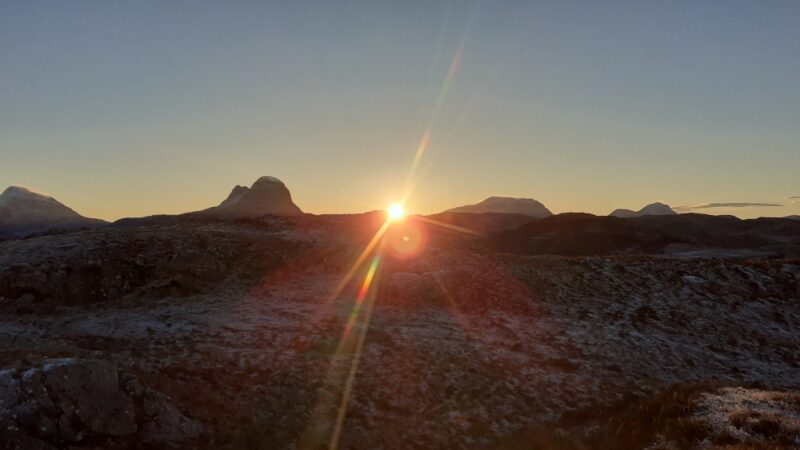
Lochinver, Assynt, Scotland
3rd December 2023
The sun rises beside Suilven, above the high rough line of moorland on the skyline, beyond the rhododendrons in the garden, behind the alder. It illuminates the leaf-rims and twigs in the path of its round shining which, glistening in the morning frost, appear to spiral sunward. It looks as if the sun is spinning an orb web, netting not just the trees but all the little wings, fluttering bodiless and backlit, at the feeder hanging from the alder.
The wings are so delicate, translucent almost, vanishing as soon as they appear, returning to the sun. Is this what we want? To be drawn sunward, to lean in, to dissolve in this echo of summer warmth, this bare brightness, this love.
Lochinver, Assynt, Scotland
16th November 2023
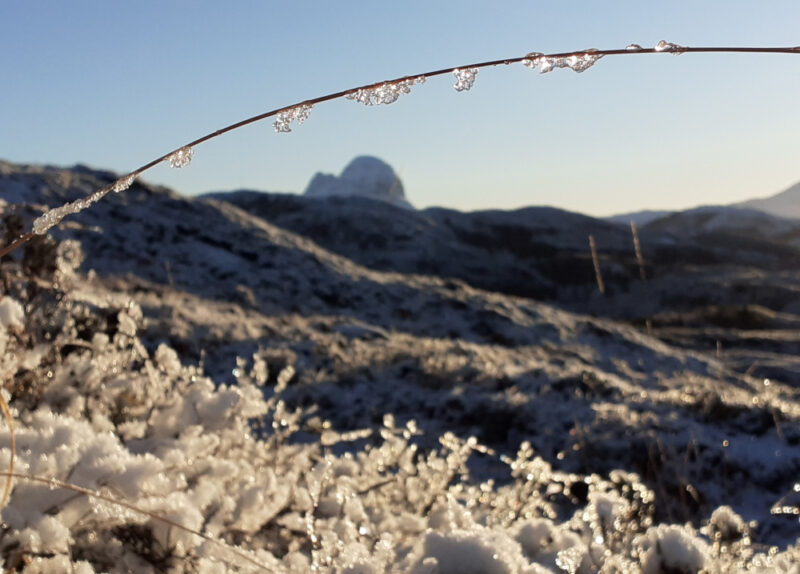
Suilven, Assynt, Scotland
12th December 2022

Old gold,
light out of time
8th December 2022
Lochinver, Assynt, Scotland

Stac Pollaidh, Wester Ross, Scotland
24th February 2022
One for sorrow,
borne on fan-like wings:
sunlit, snow-tipped
concertinas of light.
Queen’s Park, Glasgow, Scotland
7th January 2022
The northerlies are tenacious this year, persisting not only throughout April but well into May. It’s hard to believe we’re only five weeks off the solstice when I’m still making fires every evening. The flowers seem to be feeling it too: the lesser celandines and violets which I remember starring the woodland floor as I took my daily walks last April have only recently begun to raise their heads. It feels as if the passage of time has stalled, that the seasons are on pause or running in slow motion. I initially assume this sensation is due to the weather but then I start to wonder how much it’s to do with the prevailing social climate too. I read in the papers online about “brain fog” – the mental listlessness and confusion that many are apparently suffering due to the monotony of life under lockdown – and it seems that the suppression of our natural life is taking its toll as well.
Things are “easing” now socially at least but it’s all so different to last spring. I remember driving to Lochinver ahead of the first lockdown thinking how incongruous it was that just as the natural world was coming into bloom – with sunshine and daffodils fairly bounding along the glens – the human world was closing down. This spring it’s the other way round: we humans are tentatively opening up but winter is stubbornly hanging on – cold, fixed, relentless.

Rosehall trails, Sutherland, Scotland
13th May 2021
a few flakes
fall
futilely,
fleetingly
and
unflurriedly
like
fickle
floating
fluff
10th February 2021
Cwm Garw, Glamorgan, South Wales
I sit on my sofa-bed trying to read. I’m bathed in radiation, nestled between the soft light of the bulb hanging above me and the warm breath of the fan heater in front, but the comfort doesn’t console me. I’m trying to read the book which is in my hands, trying to catch hold of the words on the pages and find their connected meaning, but it’s difficult. It’s as if I can’t get in. My brain slips on the surfaces, lapsing instead of latching, and I find myself stumbling repeatedly over mysterious unseen obstacles.
“I begin with haard’dloq, extremely thin new ice that cannot be stepped on without danger, and then hikuliaq, new ice which is still slippery and yet can be travelled across.” *
Perhaps the subject matter isn’t helping and I wonder if it’s strange that I’m choosing to read about ice just now. It’s the season for it, I suppose, but it’s been a mild winter here so far. The temperature has rarely dropped towards zero and nothing has frozen yet. There hasn’t even been frost this week, the air being too wet and wild to permit any kind of stasis. I don’t think there’s much in our freezer either: the congealed mass of peas which I held to my head after bouncing it off a rock has long since been cooked and eaten. Nonetheless, I find it hard to get a grip. Words slide from the pages as I read, their crystallisations of meaning melting out of memory almost as soon as they’ve assembled, or sometimes before. It’s not that there are gaps – I’m not aware of any specific absences or elisions – but the greater order of things eludes me. On the rare occasions when I do manage to gather some sentences together, the reason for their proximity remains opaque.
Maybe I’m trying too hard. My consciousness is so clumsy at the moment, skiting across the veneer of the world ungracefully – and ungraciously. Yet, because or in spite of this, other things are drawing my attention. Maybe they’re always there and it’s only now I notice but lately I’ve been encountering all these little consonances; things echoing and repeating in different places. Photographs of snowflakes I see online recrystallise unexpectedly on the pages of a book, floods seep out of pages and into the fields around me, a phrase uttered by a character in an old Northern Exposure DVD is repeated by my boyfriend in the kitchen half an hour later. It’s as if different fields of existence are resonating, as if life itself is rhyming a bit.
I’m not sure what’s going on – if I am picking up on some subtle patterning or am simply confused. I’m certainly disorientated. Indeed, in some ways it seems that the world is inverted; as if I’m trapped on underside of ice and observing life from there. The most familiar things appear strange and at times I barely recognise myself.
It’s not just the brain injury, though that’s a big part of it. It’s also the lockdowns, the endless reiterating train of them: closing down, shutting up, holding in, keeping apart. Their effects are not just superficial. Like everything living, we’re not so much entities as processes – doings, motions, living veins running through the world. And when our activities are frozen and our moving stopped, we ice over, we ossify, we lose hold, not only of our livelihoods and of the human animals that we love but of our very companionship with ourselves.
It’s a discouraging time, all in all, but the consonances give me heart. Each time I meet one it’s like a warm touch, reassuring me that I’m still in favour with the world, still alive among its undercurrents even as I struggle at the surface. Indeed, during these moments I begin to feel a sense of belonging again; a sense that I’m inhabiting a deeper part of my brain and a deeper part of my body – a place beneath the stalled outer layers where my movement is more fluid, my contact more true. It’s a confirmation, a reminder, and a relief: that there’s life beneath; there’s always life beneath.
*Nancy Campbell, The Library of Ice (London: Scribner, 2018, pp. 112-3)
Pontycymer, Glamorgan, South Wales
12th January 2021